
TL;DR — What You Need to Know
The Moment a Competitor Gets Recommended Instead of You
A managing director at a mid-size Nairobi company needs a strategy consultant. She has used consultants before. She has a rough idea of what she needs. She opens ChatGPT and types: “Who are the best strategy consultants for mid-size companies in Nairobi?”
ChatGPT generates a response. It may mention firm names. More likely, it mentions specific individuals — people whose expertise it has been trained on, whose names appear in credible external sources, whose published thinking on strategy and business transformation it can point to.
If your name appears in that answer, you have just entered a serious commercial conversation before the prospect has visited a single website. If it does not — and your competitor’s does — you were never in the race.
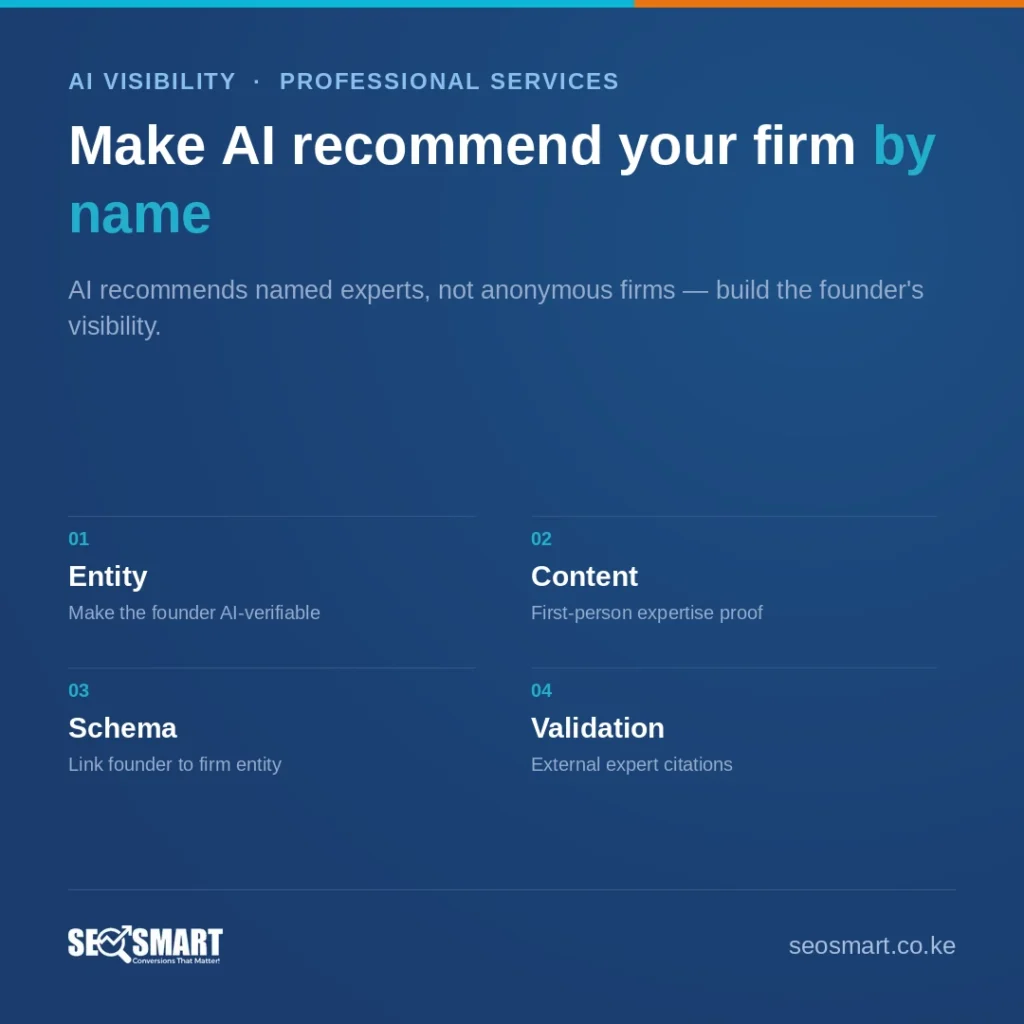
This dynamic is not unique to strategy consulting. It plays out for accountants, marketing agencies, financial advisers, architects, IT consultants, HR professionals, and every other professional services category. The fundamental shift is this: AI recommends experts by name. Not anonymous firms. Not company websites. Named, credible, verifiable human experts.
For founder-led and expert-led businesses, this is the biggest competitive opportunity in digital marketing right now. You have the expertise. You just need to make it visible in the right way.
This article is part of the AI Visibility Engine knowledge cluster. It builds directly on two foundational articles: entity authority — because founder entity is the core mechanism here — and E-E-A-T signals — because expertise demonstration is the primary content strategy. Read those first if you have not already.
How AI Actually Recommends Professional Services — And Why It Favours Individuals Over Firms
Understanding why AI gravitates toward named individuals rather than anonymous firms is the foundation of everything in how the AI Visibility Engine applies to professional services.
When AI generates a recommendation for a professional services provider, it is essentially asking: “Who can I cite with confidence?” Confidence requires verification. And for professional services — where the value delivered is entirely dependent on the expertise and judgment of specific people — AI verifies at the person level, not the company level.
Think about how you evaluate a professional services firm when you have never heard of them. You look at who runs it. What their background is. Where they have worked. What they have published. Who has recommended them. Whether their clients say they are good. You are building a picture of individual credibility, not company credibility. AI does exactly the same thing — it just does it faster, across a much wider information base, and with a strong preference for sources it can clearly attribute to verifiable individuals.
This creates a structural advantage for founder-led businesses that most firms have not yet recognised. A solo consultant with strong personal entity authority — a well-documented LinkedIn profile, published articles on their expertise, external mentions in credible sources, a website where they personally author content — will consistently be cited by AI over a larger, better-resourced firm whose content is anonymous and corporate.
How Different AI Platforms Approach Professional Services Recommendations
ChatGPT draws from its training data and, when browsing is enabled, from Bing-indexed content. For professional services recommendations, it weights personal credibility signals heavily: named individual authorship, LinkedIn presence, published thought leadership, external expert citations. A consultant who has published substantive, specific articles on their expertise area — and whose name appears in external sources as a quoted expert or referenced authority — surfaces reliably in ChatGPT professional services queries.
Perplexity pulls from real-time web content and cites sources explicitly. For professional services, it indexes and cites content from individual experts’ websites and blogs readily — especially content that directly answers the questions prospective clients ask before hiring a consultant or adviser. Perplexity is often the fastest AI citation path for professional services founders because it rewards fresh, specific, expert-attributed content regardless of firm size.
Google AI Overviews for professional services queries draws from well-ranked web content and treats personal brand authority — named authorship, strong LinkedIn signals, external validation — as primary credibility indicators. The correlation between AI Overview inclusion and top-10 Google rankings applies here, meaning that a consultant who ranks well for their primary expertise keywords and has strong personal E-E-A-T signals will appear in both traditional and AI Overview results.
LinkedIn deserves special mention for professional services specifically. While not an AI tool itself, LinkedIn content is one of the most heavily indexed sources that AI models — particularly ChatGPT and Gemini — draw from for professional expertise assessments. A consultant with consistent, substantive LinkedIn content demonstrating their expertise is building AI citation authority with every post, even if they do not have a blog.
How the AI Visibility Engine Works for Professional Services: Five Layers of AI Citation Authority
We call this application the Founder Visibility Engine — the same AI Visibility Engine method used across every industry we work in, weighted here toward founder entity signals.
Layer 1: Founder Entity Authority — Making the Person Behind the Brand AI-Verifiable
This is the most important layer for professional services — and the one that most directly maps to the entity authority framework in the entity authority guide. For a professional services firm, the founder’s personal entity authority is the firm’s citation authority. They are inseparable.
Building founder entity authority means creating a complete, consistent, cross-referenced digital identity for the individual who represents the firm’s expertise. This involves five specific components:
A complete, substantive author bio page on the firm website. Not a one-paragraph corporate biography. A full page that covers: their specific expertise areas and the types of problems they solve, their professional background and relevant experience, their qualifications and credentials, any publications, speaking engagements, or external mentions, links to their LinkedIn and any other verified professional profiles, and a list of articles they have authored on the site. This page is the hub of the founder’s entity on the firm’s own domain — everything else points back to it.
A complete, active LinkedIn profile. LinkedIn is the single most important platform for professional services founder entity authority. AI models trained on professional content weight LinkedIn heavily as a verification source for individual expertise. The profile needs: a professional headline that states the specific expertise area (not just the job title), a detailed About section written in first person that describes what problems you solve and for whom, specific examples of client outcomes, skills endorsed by credible connections, and regular content that demonstrates expertise. Importantly — LinkedIn content that generates genuine engagement (comments, shares) is a stronger entity signal than passive profile completeness.
Consistent name and credential format across all platforms. The same version of your name, with the same credential abbreviations, appearing consistently across your website, LinkedIn, any published articles, directories, and social media profiles. This consistency is what allows AI to confidently identify all these references as the same person and aggregate them into a single, strong entity signal. Any inconsistency — using “J. Mwangi” on some platforms and “James Mwangi” on others, or listing credentials differently — fragments the entity signal.
Person schema on the author bio page. The technical implementation that makes the founder’s identity machine-readable to AI crawlers. The Person schema should include their name, URL, job title, description, knowsAbout (specific expertise areas), worksFor (linking to the firm’s Organisation schema), and sameAs (linking to their LinkedIn and other verified profiles). This schema creates a direct entity link between the individual and their employer firm — meaning when AI identifies the founder as authoritative, it simultaneously strengthens the firm’s entity authority.
Google Business Profile completeness. For professional services practices with a physical location, a complete, accurate, and regularly updated Google Business Profile is an entity corroboration signal. The profile name, address, category, description, and website URL should exactly match what is on the firm’s website. Reviews on Google Business Profile — especially those mentioning the founder by name — are valuable third-party entity validation.
Layer 2: Thought Leadership Content — Demonstrating Expertise AI Can Extract
For professional services, content is not just a traffic strategy. It is the primary mechanism through which AI learns what you are an expert in. The content you publish defines the expertise areas AI associates with your name.
This is a completely different content frame from traditional marketing content. The goal is not to attract website visitors or generate leads directly. The goal is to demonstrate specific, verifiable expertise on the exact topics your prospective clients ask AI about — so that when those queries are submitted, your content is the most credible, direct answer available.
Thought leadership content for AI citation has four requirements that are non-negotiable:
First-person, experience-based perspective. AI specifically rewards the first “E” in E-E-A-T — Experience. Content written as “we help clients with…” or “our team believes…” gives AI no individual expertise signal to extract. Content written as “In my experience working with Kenyan SMEs on their growth strategy, I have found that…” gives AI a direct, first-person expertise claim from a named individual. This is not just stylistic preference — it is a material AI citation signal. Write every piece of thought leadership in first person, from your specific perspective, drawing on your actual experience.
Specific, verifiable claims rather than general assertions. “I am an expert in digital marketing” is a claim AI cannot verify and will not cite. “I restructured T9 Professionals’ service pages around the terms UK buyers actually use to find ERPNext consultants, and they are now named by ChatGPT, Gemini and Google AI Overviews for those queries” is specific, checkable by anyone willing to run the query themselves, and attributable to a named individual’s real-world work — see the T9 Professionals case study. The specificity is what makes it citable. Generic expertise assertions are the most common content failure in professional services — they sound confident but give AI nothing to work with.
Direct answers to the questions clients ask before hiring you. What does a prospective client need to understand before they decide whether to hire a consultant like you? What questions do they ask in the first meeting? What concerns do they have? Build content around those exact questions — not around showcasing your methodology or explaining your process. “How do I know if my business is ready to hire a marketing consultant?” is a question a prospect asks AI. “Our Marketing Engagement Framework” is a brochure section nobody searches for.
Consistent topical focus. AI builds expertise associations through patterns of content. Publishing ten articles on ten different topics signals a generalist. Publishing ten articles that all illuminate different dimensions of a specific expertise area — with a content cluster structure connecting them — signals a specialist. For AI citation, being a clearly defined specialist in a specific domain is significantly more valuable than being broadly knowledgeable across many areas. This is the content layer of the entity authority principle: your content cluster is your expertise declaration.
Layer 3: Professional Services Schema — The Technical Identity Layer
Schema markup for professional services combines ProfessionalService (or the more specific subtype relevant to your category), Person schema for the founder, and Article schema with full author attribution on every piece of published content. Together these give AI a complete, machine-readable map of who you are, what you do, and that the content on your site was produced by a specific, verifiable expert.
The ProfessionalService schema for a consultancy or agency:
<script type="application/ld+json">
{
  "@context": "https://schema.org",
  "@type": "ProfessionalService",
  "name": "Your Firm Name",
  "url": "https://www.yourfirm.com",
  "telephone": "+[your number]",
  "description": "A two-sentence description of your firm's specific expertise and the clients you serve.",
  "knowsAbout": [
    "Digital Marketing Strategy",
    "SEO and Content Marketing",
    "AI Visibility Optimization",
    "Conversion Rate Optimization"
  ],
  "areaServed": [
    { "@type": "City", "name": "Nairobi" },
    { "@type": "Country", "name": "Kenya" }
  ],
  "founder": {
    "@type": "Person",
    "name": "Mehul Shah",
    "url": "https://www.seosmart.co.ke/about/mehul-shah/",
    "sameAs": "https://www.linkedin.com/in/[your-linkedin-slug]"
  },
  "address": {
    "@type": "PostalAddress",
    "streetAddress": "Your Street Address",
    "addressLocality": "Nairobi",
    "addressCountry": "KE"
  },
  "sameAs": [
    "https://www.linkedin.com/company/your-firm",
    "https://twitter.com/yourhandle"
  ]
}
</script>
The founder property is the most important addition for professional services schema. It creates a direct, machine-readable link between the firm entity and the individual founder entity — so when AI identifies the founder as a credible expert, that credibility is explicitly connected to the firm. Most professional services websites have neither this schema nor the Person schema for the founder. Both are straightforward to add and have a disproportionate impact on AI citation for founder-led businesses.
The knowsAbout property on both the firm schema and the founder’s Person schema declares the specific expertise domains AI should associate with this entity. Be precise and specific — these should reflect your actual primary expertise areas, not aspirational keywords. Full schema implementation guidance is in the Schema Markup for Small Business guide →
Layer 4: External Expert Validation — The Signals AI Trusts Over Your Own Claims
In professional services, external validation is what separates a self-proclaimed expert from a verified one. And AI, which has been trained to be sceptical of self-promotion, weights external validation extremely highly — particularly for categories where anyone can claim expertise without formal licensing requirements.
Published articles in industry and business publications. This is the single most impactful external validation signal for professional services AI citation. A consultant or agency founder who has been published in a respected industry publication — whether that is a marketing trade journal, a business newspaper, an industry association newsletter, or a respected business blog — has received an implicit third-party endorsement of their expertise. AI models trained on those publications carry that endorsement forward. Even a single well-placed article in a credible publication can meaningfully shift AI’s confidence in citing you.
Quoted as an expert in journalism and media. Being cited by name as an expert source in articles, podcasts, or broadcast media is a powerful authoritativeness signal. Proactively building media relationships — using platforms like ProfNet or HARO (Help A Reporter Out), or directly pitching expertise to business journalists covering your sector — is a systematic way to generate the kind of expert citations that compound into AI authority over time.
Speaking at industry events and conferences. Conference presentations — especially at events with web presences that index speaker profiles — generate multiple entity signals simultaneously: your name is associated with the event entity, the topic entity, and the expertise domain. Publishing your speaking slides or a written summary of the presentation extends these signals to the broader web. For Kenyan professionals, speaking at events like Nairobi Innovation Week, local chamber of commerce events, or industry association gatherings creates exactly this kind of web-indexed expert mention.
Professional association memberships and directory listings. Being listed on the directory of a recognised professional association — the Kenya Institute of Management, the Institute of Certified Public Accountants of Kenya, the Chartered Institute of Marketing Kenya chapter, or any relevant professional body — provides external institutional validation that AI treats as a credibility signal. The more specific the association to your expertise area, the stronger the signal.
Client testimonials and case studies on independent platforms. Reviews on Google, LinkedIn recommendations from named clients, and detailed case studies that describe specific client outcomes by industry and result type are user-generated validation signals that AI weights heavily. A LinkedIn recommendation from a named client at a recognisable company, describing a specific outcome you delivered, is worth considerably more as an AI citation signal than a general five-star Google review.
Layer 5: Consistency Architecture — The System That Makes Everything Compound
The first four layers build your visibility. The fifth layer is what makes it compound over time rather than plateau.
Consistency architecture means building a system — not a series of one-off tactics — that continuously strengthens your entity signals, keeps your content current, and maintains the cross-platform identity consistency that AI uses to recognise and trust you.
A regular publishing cadence you can actually maintain. One substantive, expert-authored article per month on your primary expertise topic is more valuable for AI citation than ten articles published in a burst and then nothing for six months. AI tools — especially those with recency signals like Perplexity and Google AI Overviews — weight content freshness significantly. A consistent publishing cadence tells AI: this expert is actively contributing knowledge in their field. It is the content equivalent of a professional who keeps their skills current versus one who trained years ago and has not published since.
Cross-platform content distribution. Every piece of content you publish on your own site should be distributed — adapted for LinkedIn, referenced in relevant online communities (Reddit, Quora, industry forums), shared with your email list, and ideally submitted for syndication to relevant publications. Research from Stacker found that distributing content to external platforms can increase AI citations by up to 325% compared to publishing on your own site alone. Your site is the source of record. External distribution is what creates the web of external references that AI uses to validate your authority.
Regular profile and schema maintenance. LinkedIn profiles, website bios, directory listings, and schema markup all need to reflect your current expertise, credentials, and contact information accurately. Outdated information creates inconsistent entity signals. A systematic quarterly review — checking your key profiles for accuracy and updating your schema’s knowsAbout and description properties as your expertise evolves — takes less than an hour and prevents the entity fragmentation that accumulates silently over time.
Monitoring and responding to your AI visibility. Once your Founder Visibility Engine is running, track whether it is working. Manually search your name and your firm name in ChatGPT, Gemini, and Perplexity monthly. Ask the specific questions your prospective clients would ask. See if you appear. If you do not, the gap is usually in one specific layer — and the keyword map and monitoring data together tell you which one. For systematic tracking, tools like Otterly AI or Profound track AI mention rates over time.
The Founder Visibility Engine in Practice — SEO Smart as a Live Example
I am not going to ask you to take this on faith. Here is how the AI Visibility Engine, applied as the Founder Visibility Engine, works for SEO Smart itself — because we build it the same way we recommend it to clients.
When someone asks ChatGPT “who specialises in AI visibility and SEO in Kenya?” or “who is an expert in generative engine optimisation in East Africa?” — the answer should include Mehul Shah and SEO Smart. That outcome depends on exactly the same five layers I am describing in this article.
Layer 1 (Founder Entity): My name, credentials, and expertise are consistently documented across seosmart.co.ke, LinkedIn, and every professional directory where SEO Smart is listed. Person schema links my identity to the firm entity.
Layer 2 (Thought Leadership): This content cluster — the Visibility Engine articles — is the thought leadership layer. Every article is authored by me, in first person, drawing on specific client experiences. The Goodlife Pharmacy and Fly ALS case studies are specific, verifiable claims of expertise. They are not marketing copy. They are evidence.
Layer 3 (Schema): SEO Smart’s website has complete Organisation schema, Person schema for me as founder, and Article schema with my authorship on every published article.
Layer 4 (External Validation): AI Overviews is already citing Fly ALS case study content. External citations accumulate with each published article that earns links or mentions from other sources.
Layer 5 (Consistency): The content cluster publishing schedule, the quarterly entity audit, and the AI citation monitoring protocol are the consistency architecture that compounds these signals over time.
The same system works for any professional services founder in any expertise area. The specific content topics, platform priorities, and validation sources vary by industry — but the architecture is identical.
For Kenyan and East African professional services firms specifically, the AI citation opportunity is still largely unclaimed — as covered in the Kenya First-Mover article → The first management consultant, the first marketing agency, the first financial adviser in each category to build the Founder Visibility Engine properly will hold the AI citation position in that category for years.
The AI Visibility Engine by Professional Services Type
The five layers apply universally. Here is how the specific content and validation priorities shift by category.
Management and Strategy Consulting
Content priority: Case studies and frameworks. AI recommends strategy consultants based on evidence of specific business outcomes — “grew revenue by X,” “reduced operational costs by Y,” “restructured the business from Z to W.” Write case studies with specific, named (or anonymised but specific) industry examples and measurable outcomes. Develop and name a proprietary framework — “The Growth Architecture Model” or “The Strategic Clarity Framework” — and reference it consistently. Named frameworks are ownable and citable in a way that generic strategy advice is not.
Validation priority: Industry body memberships, published research or whitepapers, speaking at business conferences, being quoted in business journalism.
Marketing and Digital Agencies
Content priority: Results-led content. Client metrics — traffic growth percentages, conversion improvements, revenue attributed to digital — are the most compelling expertise demonstrations for marketing agency founders. Publish these specifically and regularly. Also: commentary on industry trends and algorithm changes, with a personal point of view. Agencies whose founders write genuinely opinionated, specific content about the marketing landscape build distinctly stronger AI authority than agencies whose content is generically educational.
Validation priority: Industry award recognition, client testimonials with specific results on LinkedIn, published articles in marketing trade publications, tool and platform partnerships that generate directory listings.
Financial Advisory and Accounting
Content priority: Tax and regulatory guidance specific to the Kenyan or relevant market context. Questions like “what are the tax implications of a Kenyan SME registering as a limited company vs a sole trader?” or “how does VAT registration work for a service business in Kenya?” are high-volume AI queries with very few credible, Kenya-specific sources. A financial adviser who systematically answers these jurisdiction-specific questions builds an almost uncontested AI citation position for Kenyan financial queries.
Validation priority: ICPAK registration or equivalent professional body membership visible on the website, client testimonials with specific financial outcomes, published articles in business press.
HR and Organisational Development Consulting
Content priority: Workplace and employment guidance specific to Kenyan employment law and cultural context. Questions like “what does Kenyan employment law require for staff redundancy?” or “how should a Kenyan employer structure a performance improvement plan?” are poorly served by existing AI sources. An HR consultant who builds jurisdiction-specific, practitioner-authored content in this space creates a significant first-mover AI citation advantage.
Validation priority: IHRM Kenya membership, speaking at HR forums, published views on employment law developments in business press.
Five Professional Services AI Visibility Mistakes That Keep You Invisible
Mistake 1: Publishing as “The Team” Instead of You
The most common and most damaging mistake in professional services content. “The team at [Firm]” is not a citable entity. You are. Every blog post, every LinkedIn article, every case study, every opinion piece should carry your name as the author. Not your firm’s name. Not “our team.” Your name, with your credentials and your perspective. AI cites people. If you are not signing your content, you are handing your AI citation authority to nobody.
Mistake 2: Content That Describes Your Service Instead of Demonstrating Your Expertise
“We offer strategic consulting services for mid-size businesses” is a service description. It tells AI what you sell. “Here is how I helped a mid-size Kenyan manufacturing company restructure their distribution model and increase margins by 18% in six months” is an expertise demonstration. It tells AI what you know and what you can do. AI cites expertise demonstrations. It ignores service descriptions. Almost every professional services firm has far more of the first type than the second. Reversing that ratio is the single highest-impact content change you can make.
Mistake 3: Inconsistent LinkedIn Presence
A LinkedIn profile with a vague headline, a three-sentence About section, and no recent activity is an entity signal that says: this person’s expertise is undefined and they are not actively contributing to their field. For professional services founders, LinkedIn is not a social media nice-to-have. It is one of the primary sources AI uses to verify and characterise individual professional expertise. Treat your LinkedIn profile as a living document of your expertise — update it when your focus evolves, post genuinely useful content regularly, and ensure your About section clearly articulates what you do and for whom in the first two lines (the visible text before “see more”).
Mistake 4: No Named Frameworks or Proprietary Concepts
Generic expertise is anonymous. Named expertise is citable. “I help businesses grow” is nothing AI can attribute specifically to you. “I use the Commercial Clarity Framework to help Kenyan SMEs identify and eliminate the three most common revenue leakage points” is something AI can associate with a specific named consultant. Every professional services founder should have at least one named, proprietary framework, model, or methodology. It does not need to be a breakthrough innovation — it just needs to be a clearly named, consistently referenced way of describing how you approach your work. Name it. Use it consistently. It becomes ownable in AI’s knowledge model.
Mistake 5: Treating AI Visibility as a Set-and-Forget Project
Building the Founder Visibility Engine is not a one-month content sprint. It is an ongoing system. The founders who will dominate AI citations in their categories in two to three years are the ones who start now and maintain a consistent cadence — one article a month, one LinkedIn post a week, quarterly profile reviews, annual external citation outreach. The compounding effect of consistent, expert-attributed content over 18–24 months creates an AI authority position that new entrants cannot displace quickly. The window to establish that position in the Kenyan professional services market is open right now.
Key Takeaways
- AI recommends named experts, not anonymous firms. In professional services, your personal entity authority is your firm’s citation authority. There is no shortcut around this — the founder must be visible for the firm to be citable.
- The AI Visibility Engine, applied to professional services as the Founder Visibility Engine, has five layers: Founder Entity Authority, Thought Leadership Content, Professional Services Schema, External Expert Validation, and Consistency Architecture. All five work together — entity authority without content gives AI nothing to cite; content without entity authority gives AI nothing to verify.
- First-person, experience-based, specific content is what AI cites. Generic service descriptions are invisible. Specific case studies, named frameworks, and first-person expertise demonstrations are citable. Rewrite your content with that distinction in mind.
- LinkedIn is not optional for professional services founders. It is one of the primary sources AI uses to characterise and verify individual professional expertise. A complete, active, expert-demonstrating LinkedIn profile is as important as your website for AI citation authority.
- Published articles in credible external publications outperform any amount of on-site content for AI authoritativeness signals. One article in a respected business or industry publication is worth more than ten articles on your own website. Build an external publication strategy alongside your on-site content strategy.
- Named, proprietary frameworks make expertise ownable. Generic expertise is anonymous. Named frameworks are attributable. Every professional services founder should have at least one.
- The Kenya and East Africa professional services AI citation window is wide open. The first consultant, adviser, or agency founder in each expertise category to build it properly — the AI Visibility Engine, applied as the Founder Visibility Engine — will hold that AI citation position for years. The compounding starts from day one.
Frequently Asked Questions
How do I get my consulting firm recommended by ChatGPT or Gemini?
Getting a professional services firm recommended by AI tools requires building the Founder Visibility Engine across five areas: founder entity authority (complete, consistent, cross-referenced personal digital identity with Person schema linking the founder to the firm), thought leadership content (first-person, experience-based, specific articles that directly answer the questions prospective clients ask AI), ProfessionalService schema (with knowsAbout declarations and a founder property linking the firm entity to the individual), external expert validation (published articles in credible publications, media citations, professional association memberships, LinkedIn recommendations), and consistency architecture (regular publishing cadence, cross-platform content distribution, quarterly profile maintenance). The core principle is that AI recommends named individuals in professional services — firm visibility follows from founder visibility, not the other way around.
Why does AI recommend individuals rather than firms for professional services?
AI recommends individuals in professional services because the value delivered by a consultancy, agency, or specialist practice is fundamentally dependent on the expertise of specific people — not the company structure around them. When AI evaluates a recommendation for a consultant or adviser, it performs the same verification a prospective client would: Who runs this firm? What is their background? What have they published? Who has cited them as an expert? This verification happens at the individual level, not the company level. An anonymous corporate entity with no named expert behind it provides AI with nothing to verify — and AI does not cite what it cannot verify. Named individuals with documented expertise, external validation, and consistent thought leadership give AI a verifiable basis for a confident recommendation.
How important is LinkedIn for professional services AI visibility?
LinkedIn is one of the most important platforms for professional services founder AI visibility. AI models — particularly ChatGPT and Gemini — draw heavily from LinkedIn for professional expertise assessment because it is the most trusted and widely used professional identity verification platform on the web. A complete LinkedIn profile clearly stating specific expertise areas, a detailed first-person About section, and regular substantive content demonstrating expertise are primary signals AI uses to characterise and verify individual professional authority. For professional services founders who do not have a personal blog or website, a well-maintained LinkedIn profile may be their single most important AI citation asset. For those who have both, LinkedIn and personal site content should be treated as complementary entity signals rather than alternatives.
What is a named framework and why does it matter for AI visibility?
A named framework is a proprietary, consistently referenced model, methodology, or approach that a consultant or expert uses to describe how they work. Examples: “The Growth Architecture Model,” “The Commercial Clarity Framework,” “The Entity Stack.” Named frameworks matter for AI visibility because they create ownable, attributable intellectual property that AI can associate specifically with a named individual. Generic expertise claims — “I help businesses grow,” “I specialise in strategic transformation” — are impossible for AI to attribute specifically to any individual because thousands of consultants make identical claims. A named framework used consistently across an expert’s content and external mentions creates a distinctive entity association that AI can recognise and cite. Every professional services founder should develop at least one named, consistently applied framework in their primary expertise area.
How long does it take for a professional services founder to appear in AI recommendations?
Initial AI visibility signals — completed founder bio page, Person schema, LinkedIn profile optimisation — can be established within one to two weeks. Meaningful citation in Perplexity and Google AI Overviews for specific expertise queries typically follows within two to three months of consistent thought leadership content publication combined with first external citations. Reliable, multi-platform AI citation for targeted professional services queries — appearing in ChatGPT, Gemini, and Perplexity when prospective clients search for your expertise category — generally takes six to twelve months of consistent Founder Visibility Engine implementation. For Kenyan and East African professional services founders, where AI has thin existing data on local experts, meaningful citation can sometimes appear faster because the competition for that AI citation position is lower.
Can a solo consultant compete with large consulting firms for AI citations?
Yes — and solo consultants often have a decisive structural advantage. Large consulting firms typically publish anonymised, committee-authored content under the firm’s brand rather than under named individuals. This gives AI nothing to verify at the individual level and produces weak citation authority relative to the firm’s actual expertise depth. A solo consultant who consistently publishes first-person, specific, experience-based content under their own name — with Person schema, external publication credits, and a strong LinkedIn presence — will consistently outperform larger firms with anonymous content in AI recommendations for their specific expertise area. The Founder Visibility Engine was specifically designed for this dynamic: individual expertise, made systematically visible, outcompetes institutional authority that is poorly documented.
What is the Founder Visibility Engine?
The Founder Visibility Engine is what SEO Smart’s AI Visibility Engine looks like applied to professional services businesses — a five-layer framework developed by Mehul Shah of SEO Smart. The five layers are: Founder Entity Authority (complete, consistent, cross-referenced personal digital identity with Person schema), Thought Leadership Content (first-person, experience-based, specific articles and case studies with named frameworks), ProfessionalService Schema (structured data with knowsAbout declarations and founder-to-firm entity linking), External Expert Validation (published articles, media citations, professional association memberships, client testimonials), and Consistency Architecture (regular publishing cadence, cross-platform distribution, quarterly profile maintenance). Its core principle is that AI recommends named individuals in professional services — building the founder’s personal AI visibility authority is the most direct path to building the firm’s AI citation authority. It is the professional-services-specific application of SEO Smart’s AI Visibility Engine — not a separate product.
How does AI visibility work?
What are AI visibility services, and what counts as the best AI visibility platform?
Ready to Become the Name AI Recommends?
The expertise is already there. You have years of experience, real client outcomes, and a specific way of thinking about your field that nobody else has. What most professional services founders lack is not knowledge — it is the systematic visibility infrastructure that translates that knowledge into AI citations, search rankings, and inbound client enquiries.
At SEO Smart, we build the AI Visibility Engine for professional services businesses across East Africa and globally — what we call the Founder Visibility Engine when it’s applied to founder-led firms. If you want to know exactly how AI currently characterises your expertise — and what it would take to become the named authority it recommends in your category — let us talk.
Talk to Mehul Shah directly:
📞 +254 722 634858 | WhatsApp the same number
🌐 www.seosmart.co.ke
Serving clients globally

Mehul Shah is the Founder and Managing Director of SEO Smart Limited, a specialised SEO, GEO and AEO agency based in Kenya. With nearly 20 years of experience, Mehul helps agencies and businesses build scalable SEO strategies, performance-optimised websites, and conversion-driven content marketing frameworks.