
By Mehul Shah · Founder, SEO Smart · · Last updated: May 2025Category: AI Visibility Engine · Reading time: ~14 minutes
How to Get AI to Mention Your Brand Online: The Visibility Engine Explained
TL;DR — What You Need to Know Right Now
The problem: Most businesses optimise for Google rankings but remain completely invisible inside AI-generated answers on ChatGPT, Gemini, Perplexity, and Google AI Overviews — where a rapidly growing share of all purchasing decisions now begin.The solution: Generative Engine Optimization (GEO) — the practice of structuring your brand, content, and online presence so that AI systems can discover, trust, and cite you when answering questions in your category.The framework: The Visibility Engine, developed by Mehul Shah of SEO Smart, is a five-channel GEO system covering Google SEO, AI assistant visibility (ChatGPT, Gemini, Claude, Perplexity), Google AI Overviews, voice search, and social media authority. It treats a website as a 24/7 digital salesperson that earns citations across every surface where customers search.The proof: SEO Smart's client Goodlife Pharmacy grew its organic visitor traffic from a near-standing start to a strong, sustained monthly flow within six months using this system. Safari airline Fly ALS now ranks all 15 tracked keywords in Google's top 10 (Fly ALS SEO report, February 2025), with Search Console impressions up from 34,232 to 58,034 between November 2024 and 30 July 2025.The core principle: AI tools cite brands they can verify as credible entities — not just keyword-stuffed websites. Building entity authority, E-E-A-T signals, structured data, and consistent cross-platform presence are the four pillars of getting AI to recommend your brand.Who this is for: Any business — from a solo consultant to a multi-location healthcare chain — that wants to be the brand AI recommends when a customer asks "who is the best [service] in [location]?"The Question That Keeps Business Owners Up at Night
A client called me recently. Frustrated. She had just asked ChatGPT: "What are the best healthcare clinics in [her city]?"A competitor — younger business, smaller team, less experience — appeared in the answer. Her clinic, which had been operating for eleven years, was not there at all."Mehul, we have been spending money on SEO for three years. How is this possible?"I told her the truth: she had been optimising for the old internet. Her competitor had been optimising for the new one.That conversation is happening in boardrooms and kitchen tables all over the world right now. Because in 2025, brand discovery has split in two. There is still Google — the blue links, the rankings, the clicks. And then there is a parallel universe of AI-generated answers, where ChatGPT processes over 2.5 billion prompts daily, where Google AI Overviews appear in an estimated 84% of searches, and where Perplexity exceeds 780 million monthly requests.In this new universe, ranking on page one of Google is not enough. You need AI to cite you.This article explains exactly how that works — and introduces the Visibility Engine, the framework I built at SEO Smart to solve this problem for businesses across every industry and every market.We have also built out a complete knowledge cluster around this topic. As you read, you will find links to deep-dive articles for specific industries and foundational concepts. Every article in this cluster is designed to be a standalone reference — so whether you are a law firm, a safari operator, or a fintech startup, there is a specific guide built for you.Let us start from the beginning.How AI Has Rewired the Way Customers Find Businesses
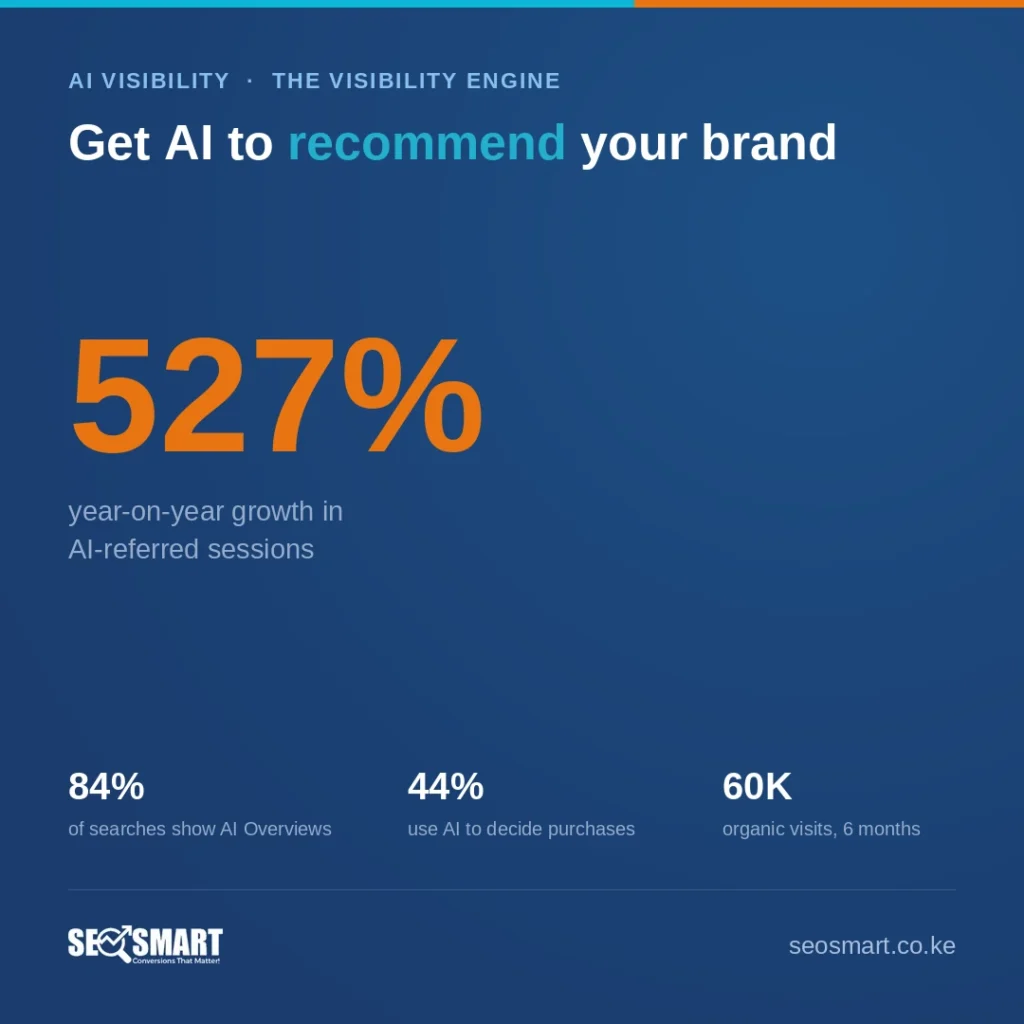
For twenty years, the internet ran on a simple logic: someone types a keyword, a search engine returns a list of links, the person clicks. Your job as a business was to be high on that list.That model still exists. But it is no longer the whole picture.Here is what the data looks like in 2025 and 2026:- AI-referred web sessions jumped 527% year-over-year in the first five months of 2025, according to Previsible's AI Traffic Report.
- Gartner predicts a 25% drop in traditional search engine volume by end of 2026 as users shift to AI tools.
- A McKinsey study estimates 44% of consumers now use AI as their primary information source for purchasing decisions.
- For B2B buyers, it is even more pronounced: 90% of B2B buyers integrate generative AI at some point in their purchasing journey, according to Walker Sands.
- Adobe research shows AI-referred visitors browse 12% more pages per visit and have a 23% lower bounce rate than non-AI referrals — meaning they are more engaged and further into the decision process.
What Is Generative Engine Optimization (GEO)?
Generative Engine Optimization — or GEO — is the practice of structuring your content and online presence so that AI systems can discover, understand, trust, and cite your brand in their generated responses.It is sometimes also called Answer Engine Optimization (AEO), LLM Optimization (LLMO), or AI Search Optimization (ASO). They all point to the same core idea: optimise not just for rankings, but for citations.A Princeton University research paper on GEO found that applying proper optimization techniques can increase a brand's visibility in AI responses by 30–40%. The same research identified that pages containing statistics, expert quotations, and well-structured citations had significantly higher AI visibility than pages without them.GEO and traditional SEO are not opposites. They share the same foundations — technical site health, quality content, credibility signals. But GEO adds specific layers on top: entity authority, structured data, direct-answer formatting, and cross-platform consistency that gives AI the clear signals it needs to trust and recommend you.I will break down exactly what those layers look like in the Visibility Engine framework below.What Is the Visibility Engine?
The Visibility Engine is the GEO framework I developed at SEO Smart after watching client after client achieve strong Google rankings — and then become completely invisible the moment a customer switched to asking an AI tool for a recommendation.The framework works across five channels simultaneously, because modern customers do not live on one platform. They start on Google, switch to ChatGPT, ask Siri a voice question, check Instagram, and come back to Google AI Overviews — sometimes within the same ten-minute research session.If your brand is missing from any one of those surfaces, you have a blind spot. The Visibility Engine closes all five at once.The Five Channels of the Visibility Engine
1. Google SEO Traditional search ranking is still essential. It remains the highest-volume discovery channel for most businesses and is deeply interconnected with AI Overviews — 76.1% of URLs cited in AI Overviews also rank in Google's top 10 results. Strong traditional SEO is the foundation everything else is built on.2. AI Assistant Visibility (ChatGPT, Gemini, Claude, Perplexity) Getting cited inside conversational AI tools when users ask questions relevant to your business. This requires entity authority, structured content, and external validation. Each platform has slightly different citation logic — we cover platform-specific strategies in detail here.3. Google AI Overviews The AI-generated answer boxes that now appear at the top of Google search results. Appearing in AI Overviews requires a combination of top-10 rankings, structured data, E-E-A-T signals, and direct-answer content formatting. Full guide to AI Overviews optimization here.4. Voice Search Voice queries via Google Assistant, Siri, and Alexa are pulling increasingly from AI-generated summaries rather than traditional web results. Being the featured answer for voice requires the same direct-answer, entity-structured content that works for AI Overviews.5. Social Media Discoverability Social platforms are not just marketing channels — they are citation sources that AI tools use to validate brand authority. Reddit, LinkedIn, and YouTube were among the top-cited sources by major AI models in late 2025. User-generated content — real reviews, community mentions, genuine testimonials — makes up 21.74% of all AI citations. Building authentic social presence and community engagement directly feeds AI visibility.The reason the Visibility Engine works is that these five channels are a flywheel, not separate silos. A well-written blog post gets cited by Perplexity, which signals authority to Google, which improves your AI Overviews ranking, which increases branded search volume, which AI models use as a trust signal. Each channel reinforces the others.The Concept That Changes Everything: Entity Authority
If I had to name the single most important concept for getting AI to mention your brand, it would be this: entity authority.Here is a simple way to understand it.When you think of Coca-Cola, you do not just think of a keyword. You think of a brand — a specific thing that exists in the world, with properties (red cans, fizzy drinks, American company), relationships (associated with happiness, sports, summer), and a reputation (trusted, global, established). That 360-degree understanding is what makes Coca-Cola an entity in the knowledge systems of both humans and AI.Your business needs to be an entity too. Not just a collection of keywords on a website. A clearly defined, verifiable, well-connected thing that AI can confidently say: "Yes, I know what this is, I know it is credible, I can recommend it."Building entity authority means ensuring that across the entire web, the answer to these questions is clear and consistent:- What does your business do, exactly?
- Who runs it? What are their credentials?
- Where does it operate?
- What problems does it solve for whom?
- Who else on the internet validates its existence and quality?
The Four Pillars of AI Brand Visibility
Across every industry and every market we have worked in, getting AI to cite your brand comes down to four things done consistently well. Think of these as the four walls of a building — if any one is missing, the structure does not hold.Pillar 1: Entity Authority — Be a Verifiable Thing
Your business information must be complete, consistent, and cross-referenced across the web. This means your Google Business Profile, your website's structured data, your social media profiles, online directories, and any press or citation sources all describe the same entity using consistent details.Any inconsistency — a different phone number on one directory, a slightly different business name on another — is a signal to AI that your entity data is unreliable. AI tools do not cite things they cannot verify.The practical starting point: audit every place your business is listed online and standardise your NAP (Name, Address, Phone) data. Then build out entity signals through an author bio page, a Wikipedia-style "About" page, and presence in industry-specific directories.Dive deeper: How to Build Entity Authority When You Are Not a Big Brand →Pillar 2: E-E-A-T Signals — Be a Trusted Source
E-E-A-T stands for Experience, Expertise, Authoritativeness, and Trustworthiness — Google's framework for evaluating content quality, and a close proxy for what AI tools use to evaluate citation worthiness.In practice, E-E-A-T means:- Every piece of content has a real, named author with verifiable credentials
- The author's bio page exists, links to their LinkedIn, and clearly states their relevant experience
- Your business has external validation — reviews, press mentions, industry directory listings, testimonials
- Your content demonstrates genuine first-hand expertise, not surface-level summaries of what other sites say
Pillar 3: Structured Data — Speak AI's Language
Schema markup is code that you add to your website that tells search engines and AI tools exactly what type of content each page contains. FAQ schema tells AI "these are questions and answers." Product schema tells it "this is a product with a price and availability." Organization schema tells it "this is a business with these properties."A Princeton study found that including structured data, citations, and statistics in content increases probability of being cited in AI responses by over 40%. Schema markup is the most direct structural signal you can give to AI.The four schema types that matter most for AI visibility:- FAQPage schema — for your FAQ sections (highest impact for direct AI citation)
- Organization schema — for your business entity data
- Article / BlogPosting schema — for every blog post, with author and datePublished
- HowTo schema — for step-by-step instructional content
Pillar 4: Direct-Answer Content — Write Like an AI's Best Source
AI tools pull from content that directly answers questions. Not content that warms up to an answer over five paragraphs. Not content that buries the key information in the middle. Content that leads with the answer, backs it up with data, and structures itself so a machine can extract the relevant passage in one clean pull.The practical rules for direct-answer content:- Answer the primary question in the first 40–60 words of each section
- Use a clear H1 → H2 → H3 heading hierarchy, with one topic per section
- Include specific statistics every 150–200 words (vague claims are not cited)
- Write FAQ sections for every major article using actual questions your customers ask
- Keep paragraphs to 2–4 sentences maximum
- Never hide your most important information behind an introduction
How the Visibility Engine Works Across Industries
The four pillars apply to every business. But how they are prioritised and what they look like in practice varies significantly depending on your industry. Below is a quick-reference overview — and a link to the in-depth guide for each sector.The core insight across all ten industries is this: AI citation opportunity is greatest where genuine, verifiable, well-structured information is hardest to find. Industries with traditionally poor online content quality — tourism, B2B manufacturing, local professional services — have enormous AI visibility upside for the first businesses that get this right.Law Firms
The Visibility Engine strategy for law firms centres on building what I call The Legal Authority Stack — FAQ content that answers the "symptoms" of legal problems in plain language, author profiles for every named attorney, verified directory listings, and FAQ schema on every practice area page. AI tools are becoming primary legal research assistants for consumers who do not yet know they need a lawyer. The firm that answers "can my landlord evict me without notice?" in plain language, from a credible named author, wins that citation. → Full guide: AI Visibility for Law Firms: How to Get Your Practice Cited as a Legal AuthorityHealthcare & Clinics
Healthcare is the most E-E-A-T-sensitive industry online. AI tools handle medical queries with extreme caution and will only cite sources they can verify as medically authoritative. The Healthcare Credibility Stack framework prioritises named, credentialled authorship for all health content, transparent clinic information, patient outcome data where available, and medical directory verification. The businesses getting cited in healthcare AI answers are not the biggest brands — they are the most credibly documented ones. → Full guide: AI Visibility for Healthcare & Clinics: Getting Cited in Medical AI AnswersProfessional Services
Consultancies, agencies, accountancy firms, and specialist service businesses live or die by reputation. The Founder Visibility Engine framework for this category centres on a simple truth: AI links brands to the named people behind them. When searches for "SEO expert" or "best marketing consultant" return AI answers, those answers cite named individuals, not anonymous companies. Founder-led content, personal author authority, and thought leadership distribution are the primary levers. → Full guide: AI Visibility for Professional Services: Make AI Recommend Your Firm by NameTourism & Safari Operators
ChatGPT has become the world's most popular travel planning assistant. When someone asks "help me plan a safari in Kenya" or "what are the best whale watching tours in Iceland," AI is now the first point of consultation — often before a single travel site is visited. The Safari Story Loop framework builds AI citation through experience-first content: real guest stories, verified itineraries, specific location data, and review aggregation that gives AI the trust signals it needs to recommend a specific operator by name. → Full guide: AI Visibility for Tourism & Safari Operators: Get Recommended by ChatGPT TravellersE-Commerce
The e-commerce AI visibility landscape changed dramatically when ChatGPT introduced Shopping integrations and Google AI Overviews began surfacing product results. The Product Data Authority Loop framework treats merchant data quality as the primary lever — perfectly synced product feeds, complete product schema, review aggregation, and authoritative category content. Brands appearing in AI shopping answers are not necessarily the biggest retailers — they are the ones with the cleanest, most complete product data. → Full guide: AI Visibility for E-Commerce: Get Your Products into AI Shopping AnswersReal Estate
Property search is increasingly conversational — "what are the best family neighbourhoods in [city]?" and "show me three-bedroom apartments under [price] in [area]" are now common AI prompts. The Property Visibility Blueprint combines local entity authority (area-specific content, local business signals), visual speed optimisation (property images must load fast and carry structured data), and location-specific FAQ content. → Full guide: AI Visibility for Real Estate Agencies: Dominate AI Property SearchFinance & Fintech
Finance sits alongside healthcare as a YMYL category where AI is most cautious about citations. The Trust Signal Ladder framework for finance brands prioritises transparency (visible fee structures, regulatory licensing information, security certifications), named editorial authorship, and third-party validation through financial directories and press coverage. Brands that can definitively answer "is [X] safe to use?" in a verifiable way win the highest-value financial AI citations. → Full guide: AI Visibility for Finance & Fintech: Building the Trust Signals AI DemandsManufacturers & B2B Companies
B2B procurement is being transformed by AI. Purchasing managers are using ChatGPT and Perplexity to build vendor shortlists before a single sales call is made. The B2B Authority Engine framework builds AI visibility through LinkedIn entity authority, industry directory presence, technical specification content that answers procurement questions, and case study content that AI can use to validate real-world capability. → Full guide: AI Visibility for Manufacturers & B2B Companies: Get on AI Vendor ShortlistsSchools & Education Providers
Parents and students are increasingly using AI to research schools and courses — "what is the best school for [subject] in [city]?" and "compare MBA programmes in [country]" are high-volume AI queries. The Education Authority Loop framework combines value-led content (curriculum insights, learning outcomes, genuine student success stories), institutional entity verification, and alumni social proof to build the kind of educational authority AI confidently cites. → Full guide: AI Visibility for Schools & Education Providers: Be the Answer AI RecommendsAutomotive Dealers
Car purchasing research has always been extensive — now it increasingly starts with AI. "What are the most reliable used cars under £15,000?" and "best electric vehicle for a family of five" are exactly the kind of high-intent, high-consideration queries that AI is now answering with specific brand and dealer recommendations. The Inventory Authority System combines real-time inventory schema, local dealer entity signals, and authoritative buying-guide content to capture this intent. → Full guide: AI Visibility for Car Dealers & Automotive Brands: Win Conversational Car SearchesDoes This Actually Work? Real Results from the Visibility Engine
Theory is cheap. Here is what the Visibility Engine has actually produced.Case Study: Goodlife Pharmacy — Building Organic Visibility From Zero in Six Months
When Goodlife Pharmacy came to SEO Smart, they had an established physical brand across multiple locations but virtually zero organic digital visibility. No meaningful monthly visitors from search. No presence in AI-generated health answers.We applied the full Visibility Engine approach:- Technical site architecture rebuilt to give AI crawlers clean, server-side rendered content
- Health content created to full E-E-A-T standards — named pharmacist authors, medically verified information, transparent credential pages
- Entity data standardised across Google Business Profile, health directories, and all social platforms
- FAQ schema added to every major health topic page
- Content strategy built around the exact questions Kenyan consumers were asking AI tools about health and pharmacy
Case Study: Fly ALS — Organic Search Visibility Growth
Fly ALS, a Kenyan safari airline, needed to be the brand AI recommended when travellers asked about domestic air travel for safari experiences in East Africa. We built their Visibility Engine around experience-first content, itinerary-specific landing pages, and entity authority across travel directories and social platforms.Result: 15 of 15 tracked keywords now rank in Google's top 10 (Fly ALS SEO report, February 2025), with Search Console impressions up from 34,232 to 58,034 (November 2024–30 July 2025). Fly ALS now appears in AI-generated safari planning answers — the highest-intent, highest-value discovery position in their category.How to Get Started with the Visibility Engine: Your First Five Moves
You do not need to rebuild your entire website to start this process. Here are the five moves that create the most impact fastest — in order of priority.Move 1: Fix Your Entity Data (This Week)
Open a spreadsheet. List every place your business appears online — Google Business Profile, Facebook, LinkedIn, industry directories, review sites. Check that your business name, address, phone number, website URL, and category description are exactly identical on every single one. Fix every inconsistency. This is the unglamorous foundation that everything else is built on.Move 2: Create a Real Author Bio Page (This Week)
Every piece of content on your website needs a real, named author with a bio page. The bio page needs: a professional photo, a list of relevant credentials and experience, links to their LinkedIn and any published work, and a clear statement of what topics they are an authority on. This is what AI uses to validate that your content comes from a credible source.Move 3: Add FAQ Sections to Your Five Most Important Pages (This Month)
Pick your five most visited pages — probably your homepage, your main service pages, and your top blog posts. Add a FAQ section to each one that directly answers the five most common questions a customer might ask about that topic. Then add FAQPage schema markup to each FAQ. This is the single highest-leverage structural move for AI citation. See our complete guide: Schema Markup for Small Business →Move 4: Write One Definitive Answer Article (This Month)
Identify the single most common question customers ask before buying your product or service. Write a comprehensive, data-rich, directly-answered article that is the best answer to that question on the internet. Not the longest — the most useful. This is the content AI cites. One great article that AI trusts and cites is worth more than fifty thin posts that do not.Move 5: Get Three External Citations (This Quarter)
AI models learn to trust brands partly by seeing them mentioned and cited by other trusted sources. Identify three places where you could earn a genuine external mention: an industry publication, a local news site, a professional directory, a podcast, a community forum where your expertise is relevant. Reach out, contribute value, and earn the mention. Distributing your content to external publications can increase AI citations by up to 325% compared to publishing only on your own site, according to research by Stacker.One Technical Thing Most Businesses Miss Entirely
Before AI tools can cite you, they need to be able to read you. And a surprising number of websites are accidentally blocking AI crawlers without realising it.Here is a quick technical checklist to run through:- Check your robots.txt file. Make sure you are not blocking GPTBot (OpenAI's crawler), Google-Extended, Claude-Web, or PerplexityBot. Many sites block all bots by default — AI crawlers included.
- Check your Cloudflare settings. Cloudflare changed its default configuration in 2024 to block AI bots. If you use Cloudflare, check the AI Crawl Metrics page in your dashboard and whitelist the crawlers you want to allow.
- Avoid client-side rendering for important content. AI crawlers cannot execute JavaScript the way browsers do. If your key content only loads after JavaScript runs, AI tools may never see it. Important content must be server-side rendered.
- Consider an llms.txt file. This is a new standard — a simple text file that tells AI systems which parts of your site are most valuable to index and how your site is structured. Not yet universal, but worth implementing.
Key Takeaways
- AI has created a parallel discovery universe. ChatGPT, Gemini, Perplexity, and Google AI Overviews are now primary discovery channels for purchasing decisions — not just supplementary tools. Being invisible there is a serious business risk.
- GEO (Generative Engine Optimization) is the discipline that solves this. It builds on traditional SEO fundamentals but adds entity authority, structured data, and direct-answer content formatting specifically designed for AI citation.
- The Visibility Engine is a five-channel GEO framework — combining Google SEO, AI assistant visibility, Google AI Overviews, voice search, and social media authority into one integrated system that treats your website as a 24/7 digital salesperson.
- Entity authority is the single most important concept. AI cites brands it can verify as credible, well-defined entities — not keyword-stuffed websites. Building entity authority is the foundation everything else sits on.
- The four pillars are: entity authority, E-E-A-T signals, structured data, and direct-answer content. All four must be in place. Missing any one significantly reduces your likelihood of being cited.
- Every industry has a specific AI visibility opportunity. Law firms, healthcare clinics, safari operators, e-commerce brands, professional services — each has a tailored framework and a clear path to becoming the brand AI recommends in their category.
- The window is still open. The majority of businesses have not yet formalised a GEO strategy. Early movers capture citation share while competition is low. That window will not stay open forever.
- Results are real. Goodlife Pharmacy: organic visitor traffic grew from a near-standing start to a strong, sustained monthly flow within six months. Fly ALS: 15 of 15 tracked keywords in Google's top 10 (February 2025). The Visibility Engine delivers.
Frequently Asked Questions
What is generative engine optimization (GEO)?
Generative Engine Optimization (GEO) is the practice of structuring your content and online presence so that AI systems — including ChatGPT, Gemini, Perplexity, Claude, and Google AI Overviews — discover, trust, and cite your brand when generating answers to user queries. Unlike traditional SEO, which focuses on ranking in search result pages, GEO focuses on earning citations inside AI-generated responses. The two disciplines share the same foundations (technical site health, quality content, authority signals) but GEO adds specific layers: entity authority, structured data markup, direct-answer content formatting, and cross-platform consistency.
What is the Visibility Engine?
The Visibility Engine is a GEO framework developed by Mehul Shah, founder of SEO Smart. It helps businesses appear not just on Google but also inside AI-generated answers on ChatGPT, Gemini, Perplexity, and Google AI Overviews. The framework operates across five channels simultaneously: Google SEO, AI assistant visibility, Google AI Overviews, voice search, and social media discoverability. Its core principle is that a business's website should function as a 24/7 digital salesperson — earning citations and driving conversions across every surface where customers search. SEO Smart's client Goodlife Pharmacy grew its organic visitor traffic from a near-standing start to a strong, sustained monthly flow within six months using the Visibility Engine.
How do I get my brand mentioned by ChatGPT or Gemini?
To get your brand mentioned by ChatGPT, Gemini, or Perplexity, you need to build entity authority (consistent, verifiable business information across the web), E-E-A-T signals (credentialled named authors, external validation), structured data markup (particularly FAQ schema and Organization schema), and direct-answer content (articles and pages that lead with clear answers to specific questions). Each AI platform has different citation logic — Perplexity favours recency and community examples, ChatGPT favours encyclopedic authority, and Google AI Overviews strongly correlate with traditional top-10 rankings. A platform-by-platform breakdown is available in the companion article on getting recommended by ChatGPT, Gemini, and Perplexity.
How long does it take to appear in AI-generated answers?
Initial citations in AI Overviews and Perplexity can appear within 2–4 weeks of proper optimization, according to GEO industry data. Significant, consistent citation rates typically take 3–6 months. Building sustained authority that results in reliable brand mentions across multiple AI platforms — ChatGPT, Gemini, Perplexity — generally requires 6–12 months of consistent effort. The timeline varies significantly by industry competition level, existing domain authority, and the quality of entity and E-E-A-T signals already in place.
Is GEO different from traditional SEO?
GEO and traditional SEO share the same foundations — technical site health, quality content, and credibility signals. The key difference is the optimisation target. Traditional SEO targets a position in search result pages. GEO targets a citation inside an AI-generated response. GEO requires additional specific actions that traditional SEO does not: entity authority building, schema markup implementation, direct-answer content formatting, AI crawler access verification, and cross-platform consistency. Google's Danny Sullivan stated at WordCamp US 2025 that "good SEO is good GEO" — meaning if you are doing SEO well, you are building the foundation. GEO adds the specific structural and content layers on top.
What is E-E-A-T and why does it matter for AI visibility?
E-E-A-T stands for Experience, Expertise, Authoritativeness, and Trustworthiness — Google's quality evaluation framework for content. AI tools use analogous signals when deciding which sources to cite. Practically, E-E-A-T for AI visibility means: every piece of content has a real named author with verifiable credentials; the author has a bio page linked to their professional profile; content demonstrates genuine first-hand experience; and the business has external third-party validation through reviews, press mentions, and industry recognition. E-E-A-T is most critical in YMYL (Your Money or Your Life) categories — healthcare, finance, legal, and any topic where poor advice could cause harm. AI is most cautious about citations in these categories and will only recommend sources with strong E-E-A-T signals.
What is schema markup and do I need it for AI visibility?
Schema markup is structured code added to a website that explicitly tells search engines and AI tools what type of content each page contains and what specific information it includes. For AI visibility, the most important schema types are: FAQPage schema (for Q&A sections, which AI extracts directly), Organization schema (for business entity data), Article schema with named authorship, and HowTo schema for instructional content. Princeton University research found that implementing structured data alongside citations and statistics can increase AI visibility by over 40%. Yes — schema markup is essential for AI visibility, not optional.
Can small businesses compete with large brands for AI citations?
Yes — and in many categories, small businesses have a significant advantage. AI citation is not primarily determined by brand size or marketing budget. It is determined by how clearly, verifiably, and specifically a brand answers the questions being asked. A small specialist clinic with named doctors, detailed treatment content, and verified credentials will often outperform a large hospital chain with generic, committee-authored content. The same principle applies across industries. The businesses that win AI visibility are the ones that are the most credibly documented and directly helpful — regardless of size. This is the fundamental competitive opportunity in GEO for small and medium businesses right now.
What is Mehul Shah's Visibility Engine and how is it different from standard SEO?
The Visibility Engine is a GEO framework developed by Mehul Shah, founder of SEO Smart Kenya, that extends traditional SEO to cover AI assistant citation (ChatGPT, Gemini, Perplexity, Claude), Google AI Overviews, voice search, and social media authority — not just Google rankings. Its core differentiator is the integration of all five discovery channels into one system, treating them as a flywheel where each channel reinforces the others. The framework is built on four pillars: entity authority, E-E-A-T signals, structured data, and direct-answer content. It is distinct from standard SEO in that it explicitly optimises for AI citation as a primary goal, not as a byproduct of ranking.
How do I know if AI is already mentioning my brand?
The simplest free method: manually ask ChatGPT, Gemini, and Perplexity the questions your customers are most likely to ask when looking for your type of business, and see if your brand appears in the answers. For more systematic tracking, tools like Otterly AI, Profound, SE Ranking's AI Visibility Toolkit, and LLMrefs allow you to monitor brand mentions across AI platforms, track citation frequency over time, and benchmark against competitors. These paid tools send automated queries to AI platforms and analyse responses for brand mentions, giving you a measurable "share of AI voice" metric equivalent to share of voice in traditional search.
Explore the Full Visibility Engine Knowledge Cluster
This article is the pillar of a complete knowledge cluster on AI brand visibility. Every article below goes deeper on a specific aspect or industry — click through to the one most relevant to your business.Foundational Concepts
- How to Build Entity Authority When You Are Not a Big Brand
- How to Build E-E-A-T Signals When You Are Not a Household Name
- Schema Markup for Small Business: What AI Actually Needs to Cite You
- How Google AI Overviews Work — And How to Get Your Brand Inside Them
- How to Get Your Business Recommended by ChatGPT, Gemini and Perplexity
Industry Deep Dives
- AI Visibility for Law Firms
- AI Visibility for Healthcare & Clinics
- AI Visibility for Professional Services
- AI Visibility for Tourism & Safari Operators
- AI Visibility for E-Commerce
- AI Visibility for Real Estate Agencies
- AI Visibility for Finance & Fintech
- AI Visibility for Manufacturers & B2B Companies
- AI Visibility for Schools & Education Providers
- AI Visibility for Car Dealers & Automotive Brands
- AI Visibility for Hotels & Hospitality
Kenya: The First-Mover Opportunity
Ready to Become the Brand AI Recommends?
The businesses that dominate the next decade of digital marketing are not the ones spending the most on ads. They are the ones that built the deepest trust — with Google, with AI, and with the humans making decisions on the other side of the screen.The Visibility Engine is how we do that at SEO Smart. Whether you are starting from zero or have an existing SEO foundation you want to extend into AI visibility, we can build you a system that works across every channel your customers use to find you.Talk to Mehul Shah directly: 📞 +254 722 634858 | WhatsApp the same number 🌐 www.seosmart.co.ke 📍 Nairobi · Serving clients globally
Mehul Shah is the Founder and Managing Director of SEO Smart Limited, a specialised SEO, GEO and AEO agency based in Kenya. With nearly 20 years of experience, Mehul helps agencies and businesses build scalable SEO strategies, performance-optimised websites, and conversion-driven content marketing frameworks.