

Cited but Not Named: How Google’s AI Overviews Decides Who to Quote
Direct answer: Google’s AI Overviews attaches a citation to whichever page it retrieved live to support a specific sentence — not necessarily the brand it names in the text. That is why one agency’s links can appear again and again in AI answers about “AI visibility in Kenya” while its brand name is never spoken aloud. Being cited (your link is attached to a fact) and being named (the model states your brand as the answer) are two different levels of AI visibility, and they are earned in two different ways. This guide explains exactly how the selection works, why the gap exists, and how to close it.
Key Takeaways
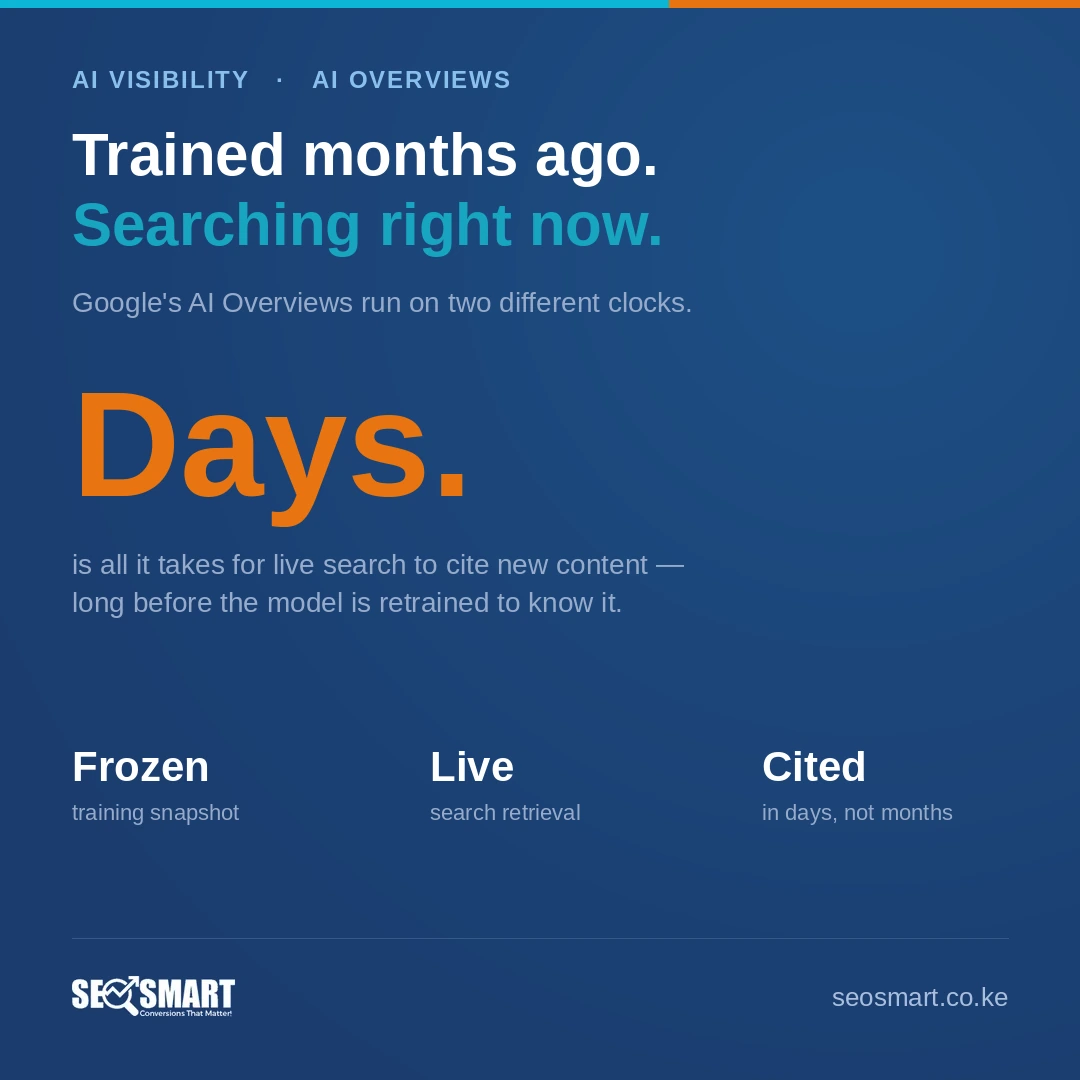
- AI Overviews runs on two clocks: a trained model (a frozen snapshot with a knowledge cutoff) and a live retrieval layer that fetches fresh web pages at the moment you ask.
- Citations are attached during live retrieval, so a well-structured site can be cited within days of publishing — long before the model is retrained to “know” the brand natively.
- There is a real difference between being cited (a link on a sentence) and being named (your brand stated as the answer). Most sites never get past citation.
- Getting cited rewards structure, clarity, freshness, and crawlability. Getting named rewards entity authority — consistent brand signals that teach the model to associate a concept with your name.
- The retraining lag is an opportunity, not a barrier: you do not have to wait months for the next model to publish content that gets pulled into answers today.
Why Does One Brand Get Cited Constantly But Never Named?
Because the link and the words come from two different places. When you ask Google’s AI Overviews a question, the model writes the answer in its own general language, and a separate grounding step attaches source links to the specific sentences those facts came from. If your page supplied the underlying data, framework, or definition the model leaned on, your URL gets stapled to that sentence — even if your company name never appears in the visible text.
This is not a glitch, and it is not favouritism. It is the default behaviour of a retrieval-augmented answer engine. The model summarises a concept in neutral language (“specialised agencies offer structured AI-visibility audits”) and then credits the page it pulled that idea from. The brand doing the most citation-worthy publishing wins the link. Whether it also wins the name is a separate question — and one most businesses never think to ask.
How Does Google’s AI Overviews Actually Choose Sources?
AI Overviews chooses sources through a live search-and-ground process, not from memory. Under the hood it runs on two separate systems working on completely different timelines, and understanding that split is the key to everything else.
The trained model — a frozen snapshot
The base model is a fixed snapshot of the web captured up to a specific knowledge cutoff. It holds language ability, reasoning, and general knowledge, but it does not automatically know last week’s blog post, a new agency launch, or a page you published this morning. That knowledge is baked in only during a full retraining cycle, which happens on an irregular cadence — typically a matter of several months, not days.
Models are not updated continuously for a technical reason: pouring fresh data into a finished model without a controlled retraining process causes catastrophic forgetting, where the network overwrites skills it already had while trying to absorb new facts. So the labs retrain in deliberate cycles rather than streaming updates minute by minute.
The live retrieval layer — the real-time patch
To cover the gap between “what the model was trained on” and “what exists on the web right now,” AI Overviews uses a live retrieval layer — the retrieval-augmented generation (RAG) pattern. When you ask a fast-moving or hyper-local question, the system fires a real-time search, reads the pages that surface, and grounds its answer in them. Those retrieved pages become the citations. This layer refreshes constantly, so a page you publish today can appear in an answer within days.
Put simply: the model provides the voice; live retrieval provides the evidence and the links. Once you understand that, the citation pattern stops being mysterious. The pages that get retrieved are the ones that rank and read well for the exact query being asked at that moment. We break down the underlying discipline in our Generative Engine Optimisation playbook.
What Is the Difference Between Being Cited and Being Named?
Being cited means the AI attached your link to a sentence as a source. Being named means the AI stated your brand as part of the answer itself — “SEO Smart does this.” These are two distinct achievements, and they sit on a ladder. Most sites that do good structural work reach the first rung. Very few climb to the second.
| Level | What it looks like | What earns it |
|---|---|---|
| Cited | Your URL appears as a numbered source link under a sentence | Live retrieval — structure, clarity, freshness, crawlability, topical match to the query |
| Named | Your brand is stated in the answer text as the recommended entity | Entity authority — consistent brand signals the model has learned to trust and associate with the topic |
Here is why the distinction matters commercially. A citation earns you a click if the reader hovers or taps the source. A name earns you the recommendation itself — the model is effectively vouching for you in its own voice. The screenshot that started this article — links appearing repeatedly with no brand mention — is a textbook picture of a site winning citation but not yet winning the name. That is a solved problem, and the fix is entity-level work, not more blog volume.
Why Is There a Lag Between What AI Knows and What It Retrieves?
The lag exists because the two systems update on different clocks. The trained model refreshes on a slow, expensive cycle measured in months; the live retrieval layer refreshes continuously. That mismatch produces a real and useful disparity.
- The core update clock (months): Labs like Google, OpenAI, and Anthropic take a new snapshot of the web and retrain the model’s weights. This is compute-heavy and infrequent, and it resets the knowledge cutoff.
- The live retrieval clock (daily/real-time): Crawlers feeding the search layer re-index the web constantly, so the sources an answer can cite change day to day.
The strategic takeaway is the part most marketers miss. You do not have to wait for the next training cycle to appear in AI answers. If your content is structured to be retrieved, the live layer can surface it now. The businesses that understand this publish for retrieval today and build entity authority in parallel, so that when the next snapshot is taken, the model absorbs a brand it has already seen cited hundreds of times. That is how a citation eventually hardens into a name.
How Do You Get Your Content Retrieved and Cited Right Now?
You get retrieved by making your page the fastest, clearest, most self-contained answer to the exact question a person asks an AI. The live layer is on a strict timer — it rewards pages it can read, trust, and quote in seconds. Five things move the needle most.
1. Lead with a one-sentence answer
Put the direct answer at the very top of each section, before any background. AI systems scan for the clearest, most self-contained statement they can lift and attribute. “We are a Nairobi digital marketing agency that helps businesses get recommended by ChatGPT and Google AI” beats three sentences of throat-clearing every time.
2. Structure for skimming, not storytelling
Use question-style headings that match what people actually ask, short paragraphs, and lists for steps, prices, or services. If a human can skim your page in two seconds, an AI can extract it in one. Our on-page SEO guide for Nairobi businesses covers the formatting mechanics in detail.
3. Prove your facts with concrete detail
Vague language gets skipped. Replace “we are local and affordable” with your exact physical address, town, country, phone number, and verifiable credentials or registration numbers. Specific, checkable facts act as a trust stamp that makes an AI confident enough to cite you.
4. Write in the language people actually use
People do not ask AI engines in old-style keywords. They ask full questions: “Which agency in Nairobi can get my business recommended by AI?” Write those exact questions into your headings and answer them plainly, the way you would explain it to a friend.
5. Stay fast, clean, and crawlable
When the live layer visits your site it is on a clock. Heavy images, bloated code, and slow load times make it give up and move to a faster page. A performant, well-structured site is a prerequisite for citation, not a nice-to-have — a point we expand on in our content strategy and pillar planning guide.
How Do You Move From Cited to Named?
You move from cited to named by building entity authority — teaching both the live layer and the eventual trained model to associate a topic with your brand name specifically. Citation is about a page; naming is about a reputation the model has internalised. The work is different.
- Schema and entity markup: Use structured data (Organisation, LocalBusiness, FAQ, Article) so machines know exactly who you are, where you are, and what you are authoritative on — not just what a single page says.
- Consistent brand signals everywhere: Identical name, address, and description across your site, Google Business Profile, directories, and citations. Contradictions make a model hedge and drop the name.
- Topical depth, not scattered posts: Cover one subject comprehensively across a pillar and its cluster so the model repeatedly sees your brand attached to that concept.
- Visible authorship and dates: Real author bylines and updated dates add the editorial accountability AI systems favour when deciding whom to trust by name.
Done consistently, these signals do two things at once. In the short term they make your pages easier to retrieve and cite. Over the long term they build the entity footprint that, at the next training cycle, gets absorbed into the model’s core memory — so the AI can name you without running a live search at all. To see how this framework separates the leaders from the laggards in one market, read our comparative analysis of AI Visibility and GEO agencies in Nairobi.
What Should a Kenyan Business Do About This Today?
Start by finding out where you sit on the ladder. Ask ChatGPT, Gemini, and Google AI Overviews the questions your customers would ask, and note whether your links appear, whether your name appears, or whether you are absent entirely. That single exercise tells you whether your problem is retrieval (structure and speed) or entity authority (brand signals and schema).
- If you are absent: Your pages are not being retrieved. Fix structure, answer-first formatting, and site speed first.
- If you are cited but not named: Retrieval is working; entity authority is the gap. Prioritise schema, consistent brand data, and topical depth.
- If you are named: Protect the position by keeping content fresh and signals consistent — naming can be lost as fast as it is won.
SEO Smart Limited builds for both rungs of that ladder at once — structuring content so it gets retrieved and cited today, while engineering the entity signals that turn a citation into a named recommendation tomorrow. That is the entire premise of our GEO approach: earn the link now, earn the name next. The AI told a user exactly how its citation logic works. The businesses that act on it will own the answers their competitors are still confused about.
FAQ
Why does Google AI cite a website’s links but not mention its name?
Because the answer text and the source links are produced by two different steps. The model writes a general answer in its own words, then a grounding step attaches the link of whichever page supplied the underlying fact. If your page provided the data but your brand name was not part of the sentence, you get the link without the name.
Is there a lag between an AI’s training data and its live search results?
Yes. The trained model is a frozen snapshot with a knowledge cutoff that only updates every few months, while the live retrieval layer refreshes continuously. New content you publish can be retrieved and cited within days, even though the model will not “natively” know it until the next full training cycle.
How often do AI models retrain their core data?
On an irregular cadence, typically measured in months rather than days. Full retraining is compute-intensive and is done in deliberate cycles to avoid catastrophic forgetting, so labs do not stream updates into the core model continuously.
How do I get my business recommended by name in AI answers?
Build entity authority: structured data (Organisation, LocalBusiness, FAQ), consistent name-address-description signals across the web, comprehensive topical coverage, and visible authorship. Getting cited rewards good page structure; getting named rewards a trusted, consistent brand footprint the model learns to associate with your topic.
Can I appear in AI Overviews without waiting for the AI to be retrained?
Yes. The live retrieval layer surfaces fresh, well-structured pages in real time, so you can be cited long before any retraining happens. Retraining is what later lets the model recall you without a live search — but retrieval gets you into answers now.

Mehul Shah is the Founder and Managing Director of SEO Smart Limited, a specialised SEO, GEO and AEO agency based in Kenya. With nearly 20 years of experience, Mehul helps agencies and businesses build scalable SEO strategies, performance-optimised websites, and conversion-driven content marketing frameworks.