
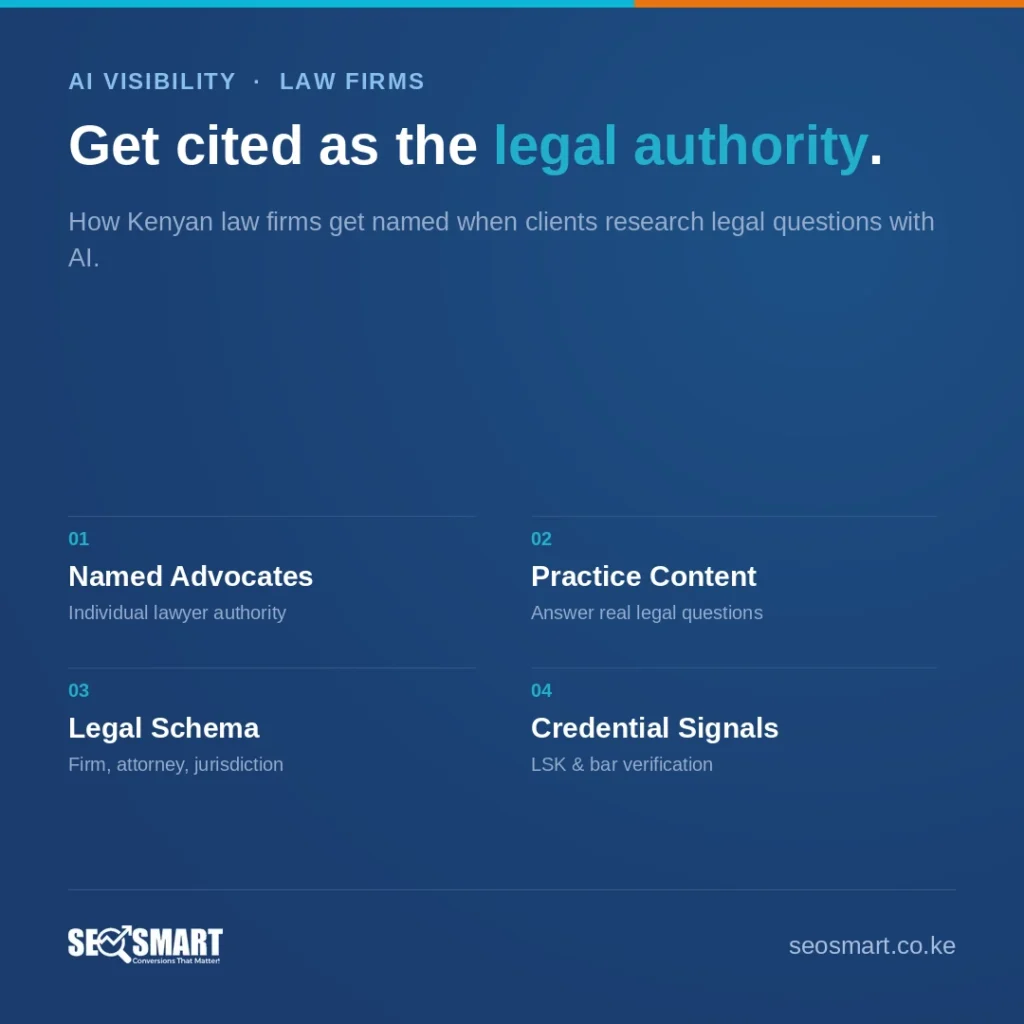
TL;DR — What You Need to Know
The Moment You Are Losing Clients Without Knowing It
A prospective client has just been handed a redundancy letter. They are sitting at their kitchen table — anxious, uncertain, not sure if they have been treated fairly. They do not reach for a directory of law firms. They do not open Google and type “employment lawyer near me.”
They open ChatGPT and type: “My employer just told me I’m being made redundant. What are my rights?”
ChatGPT generates a response. It explains the relevant legal framework. It mentions specific rights. And for a growing number of queries in a growing number of jurisdictions, it cites a specific source — a law firm whose content it has trained on or indexed as authoritative in that area.
If that source is your firm, you have just entered that client’s consideration set before a single competitor was ever seen. If it is not your firm, you were never in the race at the most critical moment of that client’s decision journey.
This is happening right now, across every practice area, in every market. And the vast majority of law firms — including highly reputable ones — are invisible in these AI-generated legal answers because their content was never built to earn citations.
This article is part of the AI Visibility Engine knowledge cluster — a comprehensive guide to getting your brand cited by AI. This is the legal industry edition. It applies the AI Visibility Engine specifically to the dynamics of legal content, legal credibility signals, and the unique challenges that YMYL classification creates for law firm AI visibility.
Before reading, it helps to understand two foundational concepts covered in the cluster: E-E-A-T signals — legal is the highest-stakes E-E-A-T category online — and schema markup — LegalService schema is the specific technical implementation for law firms. Both are central to the Legal Authority Stack.
How AI Tools Handle Legal Questions — And What That Means for Your Firm
Legal content occupies some of the most carefully managed territory in AI-generated responses. The reason is straightforward: wrong legal information can cause serious, irreversible harm to the person receiving it. AI tools know this. Their handling of legal queries reflects it in two ways that every law firm needs to understand.
First, AI is conservative about legal citations. ChatGPT, Gemini, and Perplexity all add disclaimers to legal responses recommending professional consultation. But they still cite sources for substantive legal information — and those sources are evaluated against the strictest E-E-A-T criteria of any content category online. The bar for getting cited in a legal AI answer is high. But it is clearable. And the firms that clear it first in any given practice area and jurisdiction have an enormous advantage.
Second, the platforms behave differently. Understanding which platform favours which type of legal content helps you prioritise your effort:
Perplexity pulls from real-time web sources and explicitly cites them. It indexes fresh, question-answering legal content readily — and legal FAQ pages from law firms that directly answer specific questions are exactly what it draws from. For law firms, Perplexity is often the fastest path to an AI citation.
ChatGPT draws from its training data and, for browsing-enabled queries, from Bing-indexed content. It favours content from sources that appear authoritative across multiple external references — firms with law society directory listings, press mentions, and content linked to from other credible legal sources. One well-cited, well-structured article from a credentialled named attorney will outperform ten thin posts.
Google AI Overviews treats legal queries as YMYL and applies its highest quality threshold. It strongly prefers content from verified legal practitioners, jurisdictionally specific and accurate, consistent with official legal sources. The 76% correlation between AI Overview citations and top-10 Google rankings means that strong traditional legal SEO and AI visibility reinforce each other directly here.
Gemini mirrors ChatGPT’s preference for named, credentialled legal authorship and jurisdictional specificity. Its legal citations lean toward content explicitly written by qualified practitioners with verifiable registrations.
The Legal Query Landscape: What Prospective Clients Are Actually Asking AI
Legal queries to AI tools fall into three categories, and knowing which type you are targeting shapes your entire content strategy.
Symptom queries — the person does not yet know they have a legal issue. “My landlord is refusing to return my deposit.” “My employer changed my contract without telling me.” “A company is using my photos without permission.” These are the highest-value queries for law firms. The person is describing a situation that may well require legal help — and the firm that provides a clear, credible initial answer becomes the first professional presence in that client’s awareness. This is the content category the Legal Authority Stack prioritises above all others.
Process queries — the person knows they have a legal issue and wants to understand what happens next. “How long does a divorce take?” “What is the process for making a personal injury claim?” “How does an employment tribunal work?” High-intent queries from people evaluating their options. AI citation here means being present at the moment of decision.
Validation queries — the person has received advice and is checking whether it sounds right. “Is it true that verbal contracts are legally binding?” “Can a no-fault eviction be challenged?” “Does my employer have to give me written reasons for dismissal?” These establish your firm as a credible authority whose content people use for verification — a powerful long-term positioning signal for both AI and human readers.
How the AI Visibility Engine Works for Law Firms: Five Layers of AI Citation Authority
We call this application the Legal Authority Stack — the same AI Visibility Engine method used across every industry we work in, weighted here toward E-E-A-T and regulatory trust signals.
Layer 1: Attorney Entity Profiles — The Credibility Foundation
Every solicitor, barrister, advocate, or attorney at your firm who produces or reviews client-facing content needs a complete entity profile. This is the legal industry application of the author credibility layer in the E-E-A-T guide — but the requirements are higher for law firms than for almost any other professional category, and the stakes of getting it wrong are greater.
A complete attorney entity profile for AI citation purposes requires:
- Full name — exactly as it appears on their law society or bar association registration
- Qualified jurisdiction(s) — stated explicitly. “Qualified to practise in England and Wales.” “Licensed in California and New York.” “Advocate of the High Court of Kenya, Law Society of Kenya member.” AI treats jurisdictional qualification as a critical credibility signal for legal content — content that cannot be verified as jurisdiction-accurate is not safe to cite.
- Practice areas — specific, not generic. Not “litigation” but “commercial litigation, construction disputes, and international arbitration.”
- Years qualified or called to the bar — a concrete experience marker AI uses as an expertise signal
- Professional registration number — the verifiable credential AI can cross-reference against the relevant law society or bar directory
- Law society or bar association profile URL — linked directly in the bio, so AI can follow the reference and verify the registration independently. This single link does more for your legal AI citation authority than almost anything else on the page.
- Notable cases, publications, or speaking engagements — external validation of genuine expertise beyond the basic credential
- LinkedIn profile link — the most widely cross-referenced professional verification source AI uses
This profile needs to exist as a dedicated, substantive page on your website — not a one-liner in an “Our Team” grid. It needs to be linked from every piece of content that attorney authors or reviews. And for YMYL legal content specifically, every article should carry both an author byline (the practitioner who wrote it) and a reviewer byline (a second named, credentialled attorney who has verified its accuracy).
One strategic implication worth emphasising: for smaller firms where one or two partners are the primary content producers, their personal entity authority is effectively the firm’s citation authority. Investing disproportionately in building those individuals’ online credibility — their LinkedIn thought leadership, their published articles in legal journals, their speaking appearances at industry events, their quotes in legal press — has a direct multiplying effect on the firm’s AI citation rate. This is the same principle covered in depth in the professional services AI visibility guide →
Layer 2: Symptom-First FAQ Content — Answering What Clients Actually Ask
This is the content layer of the Legal Authority Stack and the one that most directly produces AI citations. The principle is simple: build a library of content that answers the specific questions your prospective clients are actually typing into AI tools — not the questions a law firm thinks they should be asking.
The “symptom-first” framing is deliberate. Most law firm content is written from the firm’s perspective — describing services in the vocabulary lawyers use among themselves. Symptom-first content is written from the prospective client’s perspective — describing situations in the plain language that non-lawyers use when they first realise something may have gone wrong.
Here is what the difference looks like in practice for an employment law practice:
Standard law firm approach: “Unfair Dismissal Claims — Our Employment Law Services.” Describes the firm’s capabilities, the claims process, the available remedies. Written in legal terminology. Useful for clients who already know they have an unfair dismissal claim and are evaluating firms.
Symptom-first approach: “My Employer Just Fired Me Without Warning — Do I Have a Legal Claim?” Answers the specific question a person asks in the first hour after losing their job. Plain language. Jurisdiction-specific. Direct answer first. Written and reviewed by named employment law practitioners. This is the content AI cites when that person asks ChatGPT the same question.
Building a symptom-first FAQ content library requires three inputs:
Your intake questions. What are the very first questions clients ask when they contact your firm? These are live symptom queries. Document every one of them. They are your highest-priority content topics because they represent the exact moment at which a client decides whether they need legal help — and from whom.
Question-modifier keyword research. Use tools like AlsoAsked, AnswerThePublic, or the “People Also Ask” feature in Google to find the exact phrasing people use for legal queries in your practice areas and jurisdiction. Write content that exactly matches those question phrasings in the H1 — because that phrasing is what AI matches against when a user submits the same query.
AI tool testing. Open ChatGPT, Gemini, and Perplexity. Type the questions you want to own. See what they currently say. Identify the gaps — the questions they answer poorly, with insufficient specificity, or with no jurisdiction-accurate sources. Build content that fills those gaps more completely and credibly than any existing source. Those gaps are your content opportunity.
Each piece of symptom-first FAQ content should follow this exact structure:
- H1: the question, phrased exactly as a client would ask it
- First paragraph: the direct answer, in plain language, in under 60 words
- Body: the explanation, the caveats, the jurisdictional specifics, the next steps a client should take
- FAQ section: four to six related questions with direct answers — and FAQPage schema markup
- Author and reviewer attribution: named practitioner who wrote it, named reviewer who verified it, both with credentials and jurisdiction clearly stated
- Last reviewed date: prominently displayed — legal information changes, and visible review dates are a freshness and trust signal for both AI and human readers
Layer 3: LegalService Schema — Telling AI Exactly What Kind of Law You Practise
Schema markup translates your firm’s identity and expertise into a language AI crawlers can parse instantly and with confidence. For law firms, the relevant Schema.org type is LegalService — a specific subtype of LocalBusiness designed for legal practices. Combined with Person schema for each named attorney and FAQPage schema on every content page with a FAQ section, these three types give AI a complete, machine-readable map of your firm.
The LegalService schema declares your firm as a verified legal entity with specific practice areas, geographic jurisdiction, and professional registration:
<script type="application/ld+json">
{
  "@context": "https://schema.org",
  "@type": "LegalService",
  "name": "Your Law Firm Name",
  "url": "https://www.yourfirm.com",
  "telephone": "+[your number]",
  "description": "A two-sentence description of your firm's specific practice areas and the clients you serve — include jurisdiction explicitly.",
  "areaServed": [
    { "@type": "City", "name": "Nairobi" },
    { "@type": "Country", "name": "Kenya" }
  ],
  "knowsAbout": [
    "Employment Law",
    "Commercial Litigation",
    "Property Law",
    "Family Law",
    "Corporate Law"
  ],
  "address": {
    "@type": "PostalAddress",
    "streetAddress": "Your Street Address",
    "addressLocality": "Your City",
    "addressCountry": "KE"
  },
  "sameAs": [
    "https://www.linkedin.com/company/your-firm",
    "https://www.lawsociety.org.ke/find-a-solicitor/your-firm-profile",
    "https://www.facebook.com/yourfirm"
  ]
}
</script>
The sameAs property deserves special attention for law firms. Including your listing on the relevant law society’s official directory — the Law Society of Kenya, the Solicitors Regulation Authority in the UK, the relevant state bar directory in the US — creates a direct entity verification path from your website to an officially regulated professional listing. AI treats these official registry citations as among the highest-authority legal entity validation sources available. This single addition to your schema can meaningfully improve your AI citation confidence for YMYL legal queries.
The knowsAbout property is the practice area declaration that helps AI match your firm to specific query types. Be specific — “Employment Law” is better than “Law.” “Medical Negligence” is better than “Personal Injury.” The more precisely your practice areas are declared, the more accurately AI can match your content to relevant queries.
Full schema implementation guidance — including how to add these to WordPress without a developer — is in the Schema Markup for Small Business guide →
Layer 4: External Legal Authority Signals — The Validation AI Trusts Most
For legal content, external validation carries more weight than in almost any other industry. AI applies its highest scrutiny to YMYL legal content and relies heavily on third-party corroboration to verify that a source is genuinely authoritative rather than self-proclaimed. The principle from the E-E-A-T guide applies in its strongest form here: AI trusts what others say about you far more than what you say about yourself.
The external authority signals that matter most for legal AI citation, in priority order:
Law society and bar association directory listings. Your firm’s listing on your jurisdiction’s official regulatory directory is the foundational external legal authority signal. It means a recognised regulatory body has verified your right to practise. For AI, this is the legal equivalent of a medical licence — a non-negotiable baseline credibility check that AI cross-references before considering any YMYL legal content citable. Your firm’s listing must be complete, current, and linked from your website’s sameAs property in your LegalService schema.
Chambers and Partners or Legal 500 recognition. These two legal directories are among the most authoritative external validation sources in the legal industry globally. A ranking or recognition in either is a significant AI citation authority signal — AI models are trained on these publications and treat their rankings as credible expertise endorsements. Even a recommendation in a regional or specialist category carries meaningful weight.
Published articles in legal journals and publications. When an attorney from your firm publishes in a peer-reviewed legal journal, a legal news publication (The Law Gazette, Legal Week, Above the Law, the Law Society Gazette), or a respected industry trade publication — that publication is implicitly endorsing their expertise. AI models train heavily on these publications. A single published article in a respected legal publication is worth more for AI citation authority than fifty blog posts on your own website.
Quoted as an expert in legal journalism. Being cited as a named source or expert in legal news coverage is a significant authoritativeness signal AI weights highly. Building relationships with legal journalists and positioning yourself as a reliable expert source — particularly on your specific practice areas — is a long-term authority building strategy with compounding returns.
Client reviews on independent platforms. Google reviews and specialist legal review platforms provide user-generated trust validation that AI treats as credible precisely because it did not originate from you. Reviews that mention specific practice areas and describe specific outcomes — “handled my employment tribunal case and achieved [result]” — are more valuable as AI citation signals than generic five-star reviews with no substantive content.
Layer 5: Regulatory Trust Infrastructure — What YMYL Demands Before Everything Else
Because legal content is YMYL, AI applies an institutional trust check before evaluating any individual credibility signal. This check looks at whether the organisation itself presents as a legitimate, properly regulated legal practice — not just whether the content is well-written or the authors are credentialled. The institutional layer must be in place before the content layer becomes fully effective.
Professional regulation disclosure — visible and specific. Your website must clearly state which regulatory body governs your firm’s practice, with your registration number or reference. For UK solicitors: “Regulated by the Solicitors Regulation Authority (SRA number: XXXXXXX).” For Kenyan advocates: “Enrolled Advocate of the High Court of Kenya — Law Society of Kenya member (LSK No: XXXXXXX).” For US attorneys: the relevant state bar admission and registration number. This disclosure should appear on your homepage footer, your About page, and every attorney’s profile page. AI tools cross-reference these registration details against official directories as a basic YMYL verification step.
Jurisdiction clarity on every content page. Legal advice is jurisdiction-specific. A piece of content about employment law that does not state whether it applies to UK, US, or Kenyan law is potentially harmful — and AI knows it. Every legal content page must state its jurisdictional scope clearly and prominently, ideally in the first paragraph and in the article schema’s areaServed property. This is both a trust requirement and a practical service to your reader.
Content review dates and update protocols. Legal information changes. Statutes are amended. Case law develops. Regulations are revised. An article about employment rights that was accurate in 2022 may be materially wrong in 2026. Every piece of legal content must display a “last reviewed” date — and that date must reflect a genuine review process, not a cosmetic update. Content that is visibly maintained is more citable than content that is visibly abandoned. AI freshness signals penalise stale legal content more aggressively than almost any other category because the accuracy risk is highest.
A transparent editorial and legal disclaimer policy. A visible editorial policy — stating how legal content is created, who reviews it, what professional standards it is held to, and what it is not (i.e., not a substitute for specific legal advice) — is an institutional trust signal AI treats as a quality marker. WebMD has one for medical content. Law firms should have the equivalent for legal content. It does not need to be long. It needs to be specific, honest, and prominently linked from every legal article.
Privacy policy, terms of service, and contact completeness. These are baseline institutional trust signals — their presence tells AI that this is an established, transparently operating legal business. More importantly for law firms: a complete, professional contact page with your physical address, direct phone number, email, and a clear description of the geographic areas and practice areas you serve gives AI the location and service precision it needs to match your firm to location-specific legal queries.
What Legal AI Citation Content Actually Looks Like — Three Practice Area Examples
Theory is useful. Examples are more useful. Here is what the symptom-first content approach looks like applied to three common practice areas — with the specific H1, structure, and FAQ questions that are most likely to generate AI citations.
Employment Law
High-priority H1 targets: “My Employer Changed My Contract Without Asking Me — Is That Legal?” / “What Counts as Constructive Dismissal?” / “How Much Redundancy Pay Am I Entitled To?”
What to cover in body: The specific legal test (in your jurisdiction), what evidence is needed, the time limits for bringing a claim, what “without prejudice” means in context, and a clear next step — contact a solicitor if X applies to your situation.
FAQ questions to include: How long do I have to bring an employment tribunal claim? What is the difference between redundancy and dismissal? Can I be made redundant while on sick leave? Does my employer have to give me a written reason for dismissal?
Property and Housing Law
High-priority H1 targets: “My Landlord Won’t Return My Deposit — What Can I Do?” / “Can My Landlord Evict Me Without Going to Court?” / “What Are My Rights as a Tenant if My Landlord Sells the Property?”
What to cover in body: The specific tenant protection legislation in your jurisdiction, the formal process the landlord must follow, the tenant’s options at each stage, and what outcomes are realistically achievable.
FAQ questions to include: How long does an eviction take? Can I withhold rent if my landlord won’t do repairs? What is an assured shorthold tenancy and what rights does it give me? Can a landlord raise my rent mid-tenancy?
Corporate and Commercial Law
High-priority H1 targets: “What Should Be in a Shareholders Agreement?” / “What Happens If a Business Partner Wants to Leave?” / “Do I Need a Solicitor to Register a Company?”
What to cover in body: The practical business implications (not just legal theory), what happens without the right documentation, the specific risks and protections, and when professional legal input is essential versus optional.
FAQ questions to include: What is the difference between a shareholder agreement and the articles of association? Can a director be removed without their consent? What is a non-disclosure agreement and when do I need one? How long does company incorporation take?
The First-Mover Opportunity for Law Firms — Especially in Kenya
In established legal markets — UK, US, Australia — AI search optimisation for law firms is becoming competitive. Larger firms with content teams are already publishing structured, FAQ-driven, attorney-attributed legal content. Getting cited in those markets requires sustained, high-quality effort over 12-24 months.
In Kenya and across East Africa, the picture is completely different. AI models have very thin, poorly structured data about Kenyan legal matters, Kenyan legal practitioners, and the specific application of Kenyan law to the situations Kenyan clients face. When someone asks ChatGPT “can my employer reduce my salary without consent in Kenya?” or “what are a tenant’s rights under Kenyan law?” — the AI is working from a sparse source base with almost no credible, well-structured, practitioner-attributed content to draw from.
The first Kenyan law firm in each practice area to publish clear, authoritative, E-E-A-T-compliant, jurisdiction-specific content will become the default AI citation for that practice area. That position will compound over time as AI models update and cite sources that are already being cited. The full context for this opportunity is covered in the Kenya First-Mover article →
Five Legal AI Visibility Mistakes That Keep Firms Invisible
Mistake 1: Practice Area Pages Written for Lawyers, Not Clients
The most common law firm content failure. A page titled “Contractual Disputes and Commercial Litigation Services” written in the vocabulary of legal practitioners — discussing causes of action, limitation periods, and heads of claim — tells a prospective client nothing about whether they have a problem that needs a lawyer. And it tells AI nothing it can match to the symptom queries that prospective clients actually submit. Reframe every practice area page around the problems clients experience, not the services lawyers provide.
Mistake 2: Anonymous Content With No Named Author
Law firm blog content attributed to “the team” or “SEO Smart Legal” rather than a named, credentialled practitioner is effectively uncitable by AI for YMYL purposes. AI cannot cross-reference “the team” against a law society directory. It cannot verify “the team’s” jurisdiction or qualifications. Every piece of legal content needs a named attorney author with a bio page that includes their specific credentials, jurisdictional qualification, and professional registration. This is the single most impactful change most law firms can make to their content AI visibility.
Mistake 3: Content That Covers Topics But Not Questions
A 1,500-word article about “employment law” does not answer “can my employer make me redundant while I am on maternity leave?” The former is a topic. The latter is a question that maps directly to an AI query. AI tools match queries to content that directly answers them — not to content that covers the general subject area. Every piece of content in a law firm’s AI visibility strategy should be built around a specific, answerable question that a prospective client is likely to ask AI.
Mistake 4: Outdated Content Without Visible Review Dates
Legal information changes — sometimes dramatically. Employment rights thresholds change annually. Landlord and tenant legislation is regularly amended. Tax treatment of transactions evolves. A legal article from 2021 that has not been reviewed and updated is not just potentially wrong — it is a liability. AI freshness signals will consistently favour a competitor’s newer, updated content over your older, stale content in any practice area where the law has moved. Display review dates on every legal article. Build a systematic review process. Update content when the law changes — not just when you remember to.
Mistake 5: No Regulatory Registration Visible on the Website
AI tools performing YMYL credibility checks for legal content specifically look for evidence of professional regulation. A law firm website that does not display its regulatory registration — law society membership, bar association registration, SRA number, LSK number — fails the most basic institutional trust check AI applies to legal sources. This takes five minutes to fix and should be treated as an absolute prerequisite before any content investment in legal AI visibility.
Key Takeaways
- AI is now the first stop for many legal questions — before a search engine, before a directory, before a referral. The law firm whose content appears in those AI-generated answers wins the client consideration at the highest-intent moment of their journey.
- The AI Visibility Engine, applied to law firms as the Legal Authority Stack, has five layers: Attorney Entity Profiles, Symptom-First FAQ Content, LegalService Schema, External Legal Authority Signals, and Regulatory Trust Infrastructure. All five must be present. The regulatory layer must be in place before the content layer becomes fully effective.
- Symptom-first content is the content that gets cited. Write around the situations clients experience, not the services lawyers provide. Lead with the direct answer. Build FAQPage schema into every article. Use question-format H1s that exactly match what people ask AI.
- Named, credentialled, jurisdiction-verified authorship is non-negotiable for legal AI citation. Anonymous corporate content does not clear the YMYL threshold on any major AI platform. Every piece of legal content needs a named practitioner author with a complete bio page and a professional registration that AI can verify.
- External validation matters more in legal than in almost any other category. Law society listings, Chambers/Legal 500 recognition, published articles in legal publications, and client reviews on independent platforms are the authority signals AI trusts most. Self-published claims are discounted.
- Legal content must be maintained, not published and forgotten. Visible review dates, genuine update processes, and immediate correction when the law changes are trust signals for both AI and human readers — and legal freshness signals are among the most aggressively weighted by AI.
- The window is especially wide open in Kenya and East Africa. AI models have thin data on Kenyan legal matters and practitioners. The first firms to publish structured, E-E-A-T-compliant, jurisdiction-specific Kenyan legal content will hold dominant AI citation positions for years.
Frequently Asked Questions
How do I get my law firm cited by ChatGPT or Perplexity?
Getting a law firm cited by AI tools requires building across five areas: attorney entity profiles (complete bio pages with named practitioners, their specific qualifications, jurisdictional registration, and links to law society directory profiles), symptom-first FAQ content (articles that directly answer the legal questions prospective clients ask AI, with question-format headlines, plain language answers, and FAQPage schema), LegalService schema on the website (declaring practice areas, jurisdiction, and regulatory registration in machine-readable format), external legal authority signals (law society listings, legal directory recognition, published articles, client reviews), and visible regulatory trust infrastructure (registration numbers, jurisdiction disclosure on every content page, content review dates). The Legal Authority Stack addresses all five layers systematically.
Why is legal content treated differently by AI than other types of content?
Legal content is classified as YMYL — Your Money or Your Life — by Google and treated with analogous caution by all major AI platforms. YMYL classification means that inaccurate information could cause serious, real-world harm to the person receiving it. In legal content, this means wrong advice about someone’s rights, incorrect information about legal deadlines (limitation periods), or inaccurate descriptions of legal processes could directly damage someone’s legal position. AI tools respond by applying their highest E-E-A-T threshold to legal content — requiring verified professional credentials, jurisdictional accuracy, visible regulatory registration, and external corroboration from authoritative legal sources before they will confidently cite a legal content source.
What is LegalService schema and does my law firm need it?
LegalService schema is a Schema.org structured data type specifically for legal practices — a subtype of LocalBusiness. It allows a law firm to declare in machine-readable format its name, location, practice areas (via the knowsAbout property), jurisdiction served (via areaServed), contact information, and professional directory listings (via sameAs). For AI citation purposes, LegalService schema is essential because it removes ambiguity about what type of legal services the firm offers and in which jurisdictions — exactly the information AI tools need to match a firm’s content to jurisdiction-specific legal queries. Any law firm seeking AI citation for YMYL legal content should implement LegalService schema as a baseline technical requirement.
How important is it to have named attorney authors on legal blog content?
Named attorney authorship is the single most important E-E-A-T signal for legal AI citation. AI tools cannot verify the credentials of “the legal team” or an anonymous company account — they can only cross-reference named individuals against law society registries, LinkedIn profiles, and external publications. Legal content attributed to a named, credentialled, jurisdiction-verified attorney with a complete bio page gives AI a verifiable human source to attach to the content, reducing the hallucination risk of citing an unverifiable source on a YMYL topic. For high-stakes YMYL legal content specifically, adding a second named reviewer alongside the author — a practitioner who has verified the content’s accuracy — provides an additional credibility signal that further increases AI citation confidence.
What is symptom-first legal content and how is it different from standard practice area pages?
Symptom-first legal content is structured around the situations clients experience before they know they have a legal issue — “my landlord won’t return my deposit,” “my employer changed my contract,” “I received a redundancy letter” — rather than around the legal services a firm provides. Standard practice area pages describe the firm’s capabilities in legal vocabulary (“we handle unfair dismissal claims”). Symptom-first content answers the specific question a client asks AI before they know they need a lawyer. AI tools prioritise symptom-first content for citation because it directly matches the query the user submitted. It leads with the direct answer, uses plain language, and structures supporting information around the specific questions clients ask at each stage of their situation.
How often should a law firm update its legal content for AI visibility?
Legal content should be reviewed whenever the law it describes changes — which in active practice areas like employment, housing, and tax can mean several times a year. At a minimum, every legal article should be reviewed quarterly and its dateModified schema property updated when meaningful changes are made. AI tools weight content freshness heavily for legal queries because outdated legal information is a safety risk — and Perplexity and Google AI Overviews in particular favour recently updated content from credible legal sources. Research shows approximately 44% of AI Overview citations come from content published or updated in the current year. A law firm that systematically reviews and updates its legal content has a compounding freshness advantage over competitors whose content is static.
Can a small law firm compete with larger firms for AI citations?
Yes — and in specific practice area and jurisdiction combinations, small firms have a significant advantage. AI citation is not determined by firm size, marketing budget, or brand recognition. It is determined by how directly, credibly, and specifically a firm’s content answers the legal questions being asked. A two-partner employment law boutique with named attorneys, jurisdiction-specific FAQ content, and a Law Society directory listing will often outperform a large full-service firm with anonymous, committee-authored content in that practice area. The Legal Authority Stack is specifically designed for firms without large content teams or PR budgets — it prioritises the credibility and structure signals that AI weights most heavily, all of which are accessible to any firm regardless of size.
What is the Legal Authority Stack?
The Legal Authority Stack is what SEO Smart’s AI Visibility Engine looks like applied to law firms — a five-layer framework developed by Mehul Shah of SEO Smart. The five layers are: Attorney Entity Profiles (complete bio pages for every named practitioner with credentials, jurisdictional qualification, and law society profile links), Symptom-First FAQ Content (legal content built around the situations clients experience, not the services firms provide, with FAQPage schema), LegalService Schema (structured data declaring practice areas, jurisdiction, and regulatory registration), External Legal Authority Signals (law society listings, Chambers/Legal 500 recognition, published articles, client reviews), and Regulatory Trust Infrastructure (visible registration numbers, jurisdiction disclosure on every content page, content review dates, editorial policy). It is the legal-specific application of SEO Smart’s AI Visibility Engine — not a separate product.
Ready to Make Your Firm the Legal Authority AI Cites?
Most law firms have genuine expertise. What they do not have is the content architecture and credibility infrastructure that translates that expertise into AI citations at scale. That gap is fixable — and fixing it is exactly what the Legal Authority Stack is designed to do.
At SEO Smart, we build the AI Visibility Engine for professional services firms including law practices — what we call the Legal Authority Stack when it’s applied to law. If you want to know exactly where your firm stands in AI legal answers today — and what it would take to become the cited authority in your practice areas — let us talk.
📞 +254 722 634858 · WhatsApp the same number
🌐 www.seosmart.co.ke
Serving clients globally

Mehul Shah is the Founder and Managing Director of SEO Smart Limited, a specialised SEO, GEO and AEO agency based in Kenya. With nearly 20 years of experience, Mehul helps agencies and businesses build scalable SEO strategies, performance-optimised websites, and conversion-driven content marketing frameworks.